Get in touch with NEXO Beauty Labs Company
Skincare Claims Substantiation: A Brand Evidence Guide

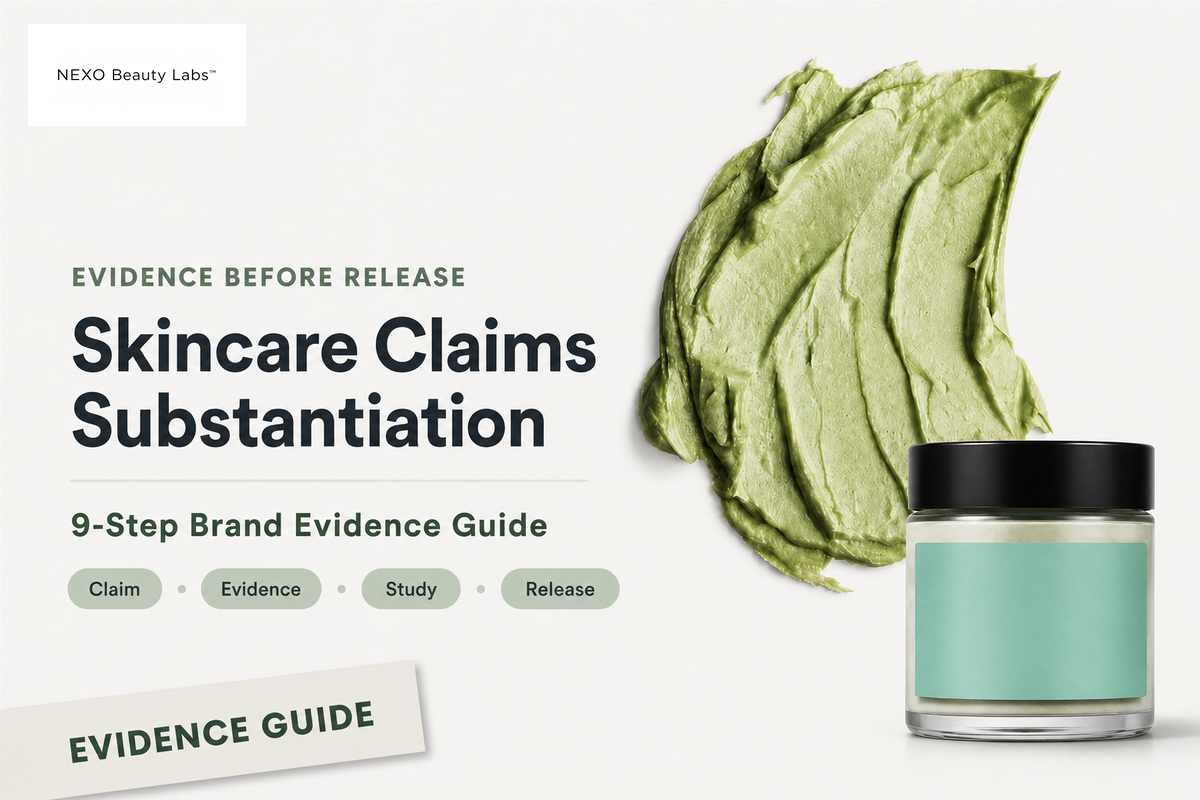
Skincare claims substantiation is the documented connection between the exact claim consumers see, the finished product and context in which they see it, and evidence fit to support that claim before release. For teams across the cosmetics industry and the wider personal care field, cosmetic claim substantiation works best when they freeze the wording and likely takeaway first, select evidence second, and approve the final execution only after the support file matches it.
The short answerUse a nine-step claim-to-release workflow: define the claim, set the market boundary, classify its meaning, match an evidence track, design the study, translate the result, assemble the release packet, check every execution, and reopen review after a material change.
9-Step Claim-to-Release Framework
The framework preserves claim meaning, evidence selection, copy approval, channel execution, and change control within one traceable chain. For advertising claim substantiation, each phase still relies on market-specific judgment; the framework is a live control, not automatic legal clearance.
Substantiation is the process that connects marketing claims to reliable scientific evidence for the specific product. For beauty and personal care brands, claims substantiation for cosmetic and personal care products should identify who is responsible for the claims, what records support each claim, and which statements concern skin care products rather than another category.
Search-query guardrailA skincare claims substantiation example can illustrate record structure, but it can’t approve another product’s wording. Skincare claims substantiation reviews should compare claim meaning, product identity, method fit, and market scope. The best skincare claims substantiation process is the one that keeps those boundaries traceable before release.
Define the Cosmetic Claim Before Selecting a Test
Scientific evidence used to substantiate claims must address what a reasonable consumer is likely to understand, including implications created by qualifiers, comparisons, images, product names, layout, audience, and channel. A positive result for “participants reported softer-feeling skin” does not automatically support a measured hydration increase, a duration promise, or a universal outcome.
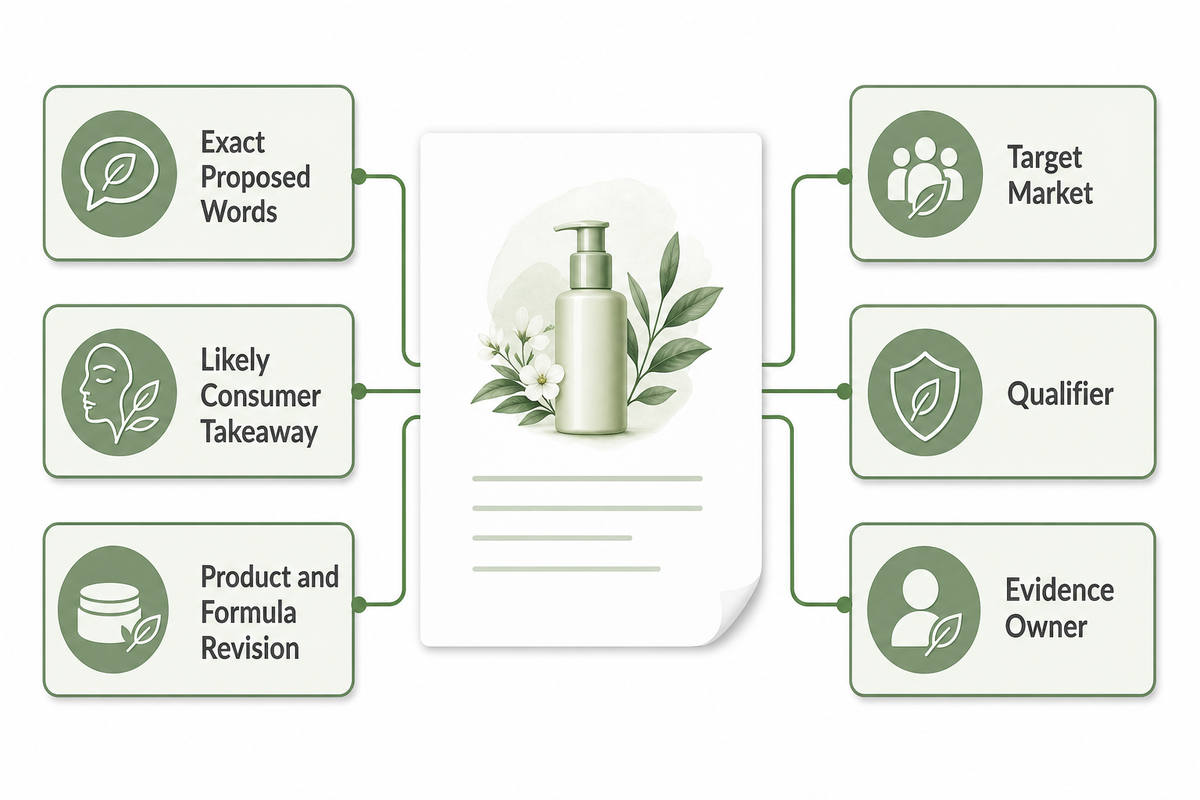
16-Field Claim Language Breakdown Card
1. Exact proposed words2. Likely consumer takeaway3. Objective or subjective4. Absolute or comparative5. Numerical or non-numerical6. Time point or duration7. Product and formula revision8. Study population9. Directions and dose10. Target market11. Audience12. Channel13. Image or demonstration14. Qualifier15. Evidence owner16. Unresolved issue
The Federal Trade Commission substantiation policy makes timing part of the control: objective claims must have a reasonable basis before they are disseminated. Evidence developed later may inform the current decision, but it does not silently erase a missing pre-release basis.
Within this workflow, “substantiating product claims is required before release” is an operating rule, not a claim that one legal test applies everywhere. Use the card to decide which claims can be substantiated, which claims need narrower wording, and whether available evidence can support claims as consumers will encounter them. Every claim that remains open stays on the release record.
Key takeaway
Freeze the claim consumers will encounter, not the result the team hopes to obtain. The 16-field card is an editorial planning tool, not a law, standard, legal opinion, or NEXO internal form.
Set Jurisdiction and Product Classification Boundaries
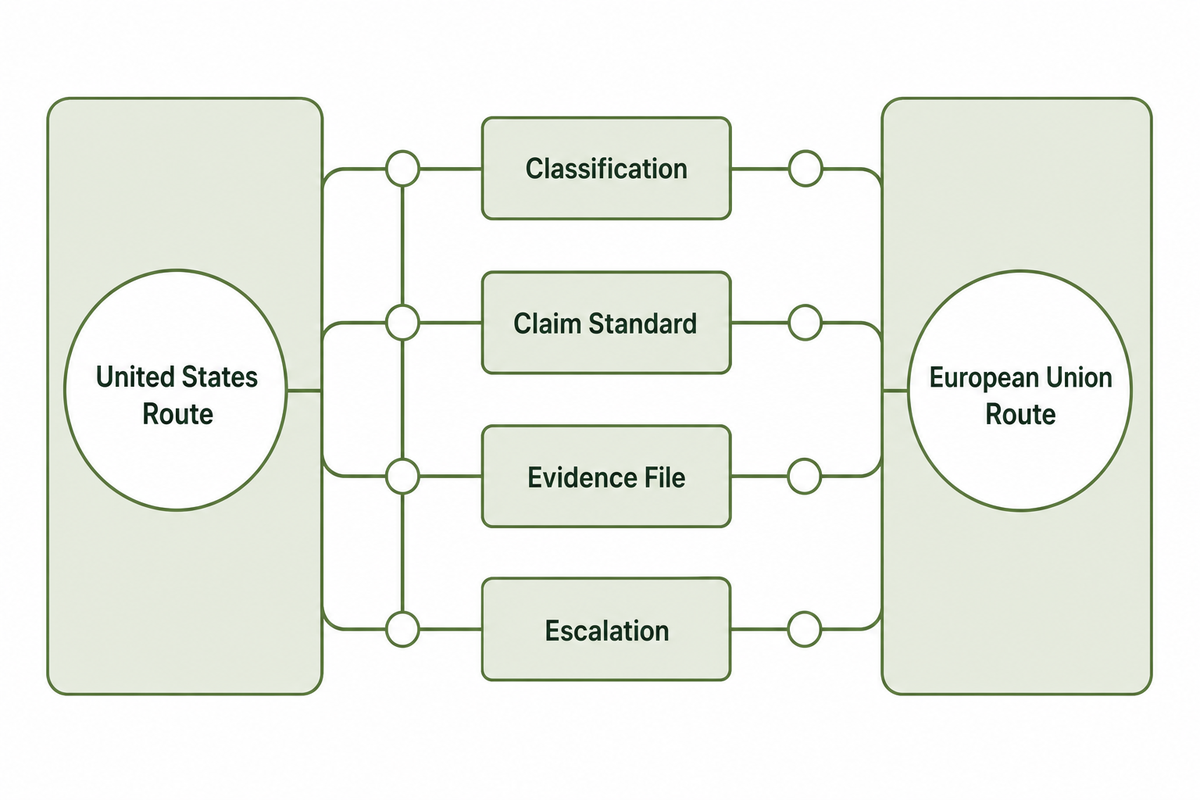
Reviews under United States and European Union cosmetics regulation ask related but different questions, so a single “global compliant” checkbox is not enough. Start with intended use and product classification, then apply the advertising, labeling, responsible-person, documentation, and professional-review duties relevant to the actual market.
| Checkpoint | United States route | European Union route | Release question |
|---|---|---|---|
| Classification | Intended use can place a product as a cosmetic, drug, or both. | Confirm the cosmetic scope and responsible-person route. | Does the complete presentation stay inside the intended category? |
| Claim standard | Objective express and implied advertising claims need a prior reasonable basis. | Claims are assessed against common criteria, including evidential support and honesty. | What proposition and net impression require support? |
| Evidence file | Retain the evidence and decision record appropriate to the claim. | Connect applicable proof of effect to the product information file. | Can a reviewer trace the released words to the retained support? |
| Escalation | Send therapeutic, disease, structure, or function implications for qualified review. | Review market, language, audience, and local interpretation. | Which unresolved question needs market-specific counsel or a regulatory professional? |
The Food and Drug Administration classification overview explains that intended use can be shown by claims and promotional context, not merely by product form. For labeling-field depth, use NEXO’s separate guide to cosmetic labeling requirements by market; this article retains the evidence-to-claim decision.
Teams may search for “EU cosmetic” requirements, but the applicable EU cosmetics regulation and cosmetic products regulation still have to be checked for the target market, while UK cosmetics regulation belongs in a separate review. SPF claims and claims related to disease, body structure, or function need classification review before the evidence plan is set.
European Union boundaryCommission Regulation (EU) No 655/2013 sets six common criteria: legal compliance, truthfulness, evidential support, honesty, fairness, and informed decision-making. It does not prescribe one universal study design for every cosmetic claim.
How Does the U.S. FTC Determine Whether a Claim Is Substantiated?
The Federal Trade Commission looks at the claim’s express and implied meaning, the product, consequences of a false claim, the cost and feasibility of support, and the level of evidence relevant experts would expect. The amount and type of substantiation can therefore change with the promise. This is a reasonable-basis framework, not automatic legal clearance for wording copied from another brand or market.
Classify the Type of Claim by Consumer Takeaway
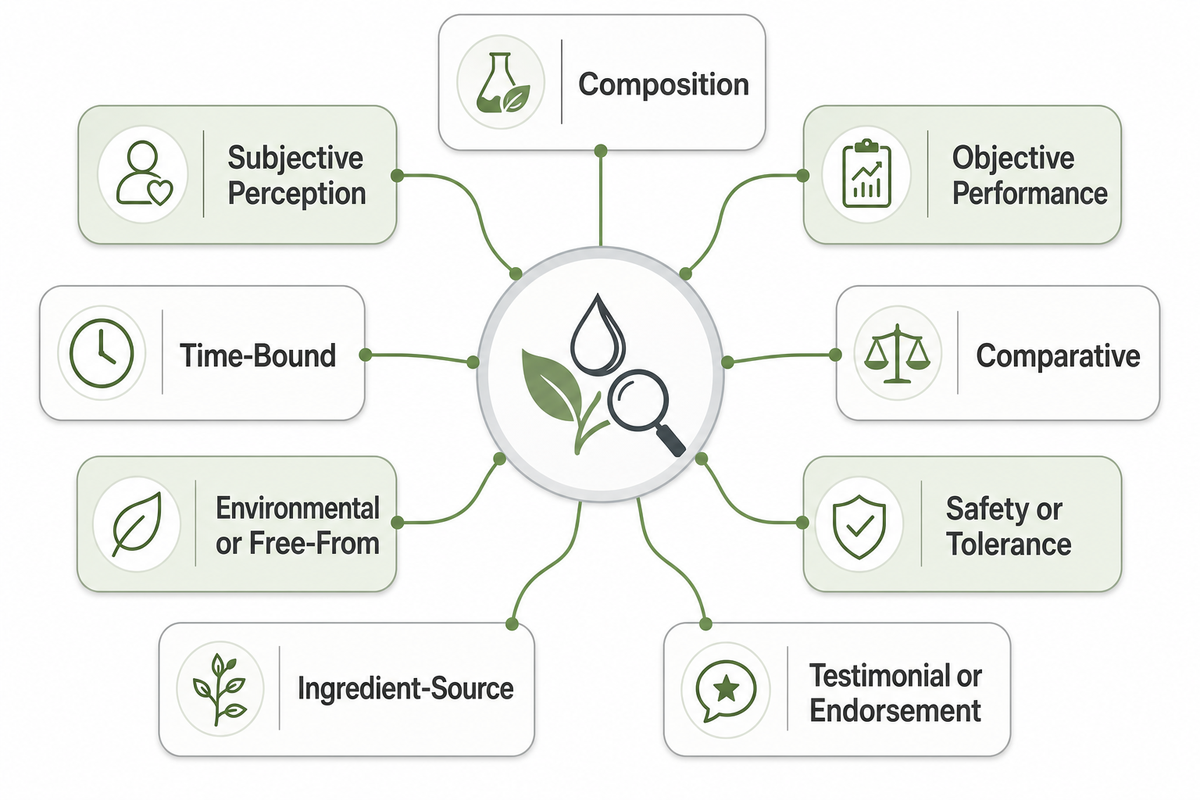
Similar beauty phrases can carry different propositions, endpoints, and risks. Classify every objective or subjective claim before choosing a method, and review all claims made across the headline, image, testimonial, product name, footnote, and demonstration.
| Claim type | Example | Evidence question | Overstatement risk |
|---|---|---|---|
| Composition | Contains hyaluronic acid | Does the controlled formula and supplier record support the statement? | Turning presence into finished-product performance |
| Subjective perception | Skin feels hydrated | What did participants report, on which scale and when? | Recasting opinion as measured physiology |
| Objective performance | Reduces the appearance of fine lines or changes a wrinkle metric | Does a suitable endpoint show the promised effect? | Dropping method, population, or product limits |
| Time-bound | Hydrates for 48 hours | Was the named endpoint measured at the claimed time point? | Extending an early result across the full duration |
| Comparative | Better than the leading serum | Is the comparator defined, current, and tested fairly? | Implying market-wide superiority |
| Environmental or free-from | Recyclable, non-toxic, or free-of | Which product, pack, threshold, market meaning, and specialized guidance apply? | Using a performance study as a safe harbor |
| Safety or tolerance | Suitable for sensitive skin | What population, endpoint, conditions, and limitations were evaluated? | Turning bounded tolerance evidence into an absolute safety promise |
| Ingredient-source | Plant-derived ingredient | What definition, chain record, formula level, and market context apply? | Extending one input fact to the whole finished product |
| Testimonial or endorsement | Creator reports smoother-looking skin | Is the experience genuine, representative or qualified, disclosed, and monitored? | Presenting one experience as a typical measured result |
A peer-reviewed exploratory study published in 2025 reviewed labels for 110 products from 13 leading brands in the Brazilian market, using data collected in 2021–2022. Its sample found terms such as “natural origin,” “safe,” and “clinically tested” were often vague or lacked clear methodological context; that’s a bounded Brazilian example, not a global prevalence estimate.
The types of cosmetic claims on a launch sheet may include aesthetic claims, objective or subjective statements, comparative promises, and similar claims expressed across different channels. Making claims about product benefits or product efficacy requires teams to separate perception from measurement. Wording such as “reduce the appearance of fine lines and wrinkles” must remain tied to the endpoint actually studied.
No automatic safe-harbor wordingDon’t invent universal permission for “dermatologist tested,” “clinically proven,” “hypoallergenic,” “clean,” “natural,” “non-toxic,” or “free-from.” Define the proposition, evidence, market, and final presentation for each one.
Match Evidence to Performance Claims
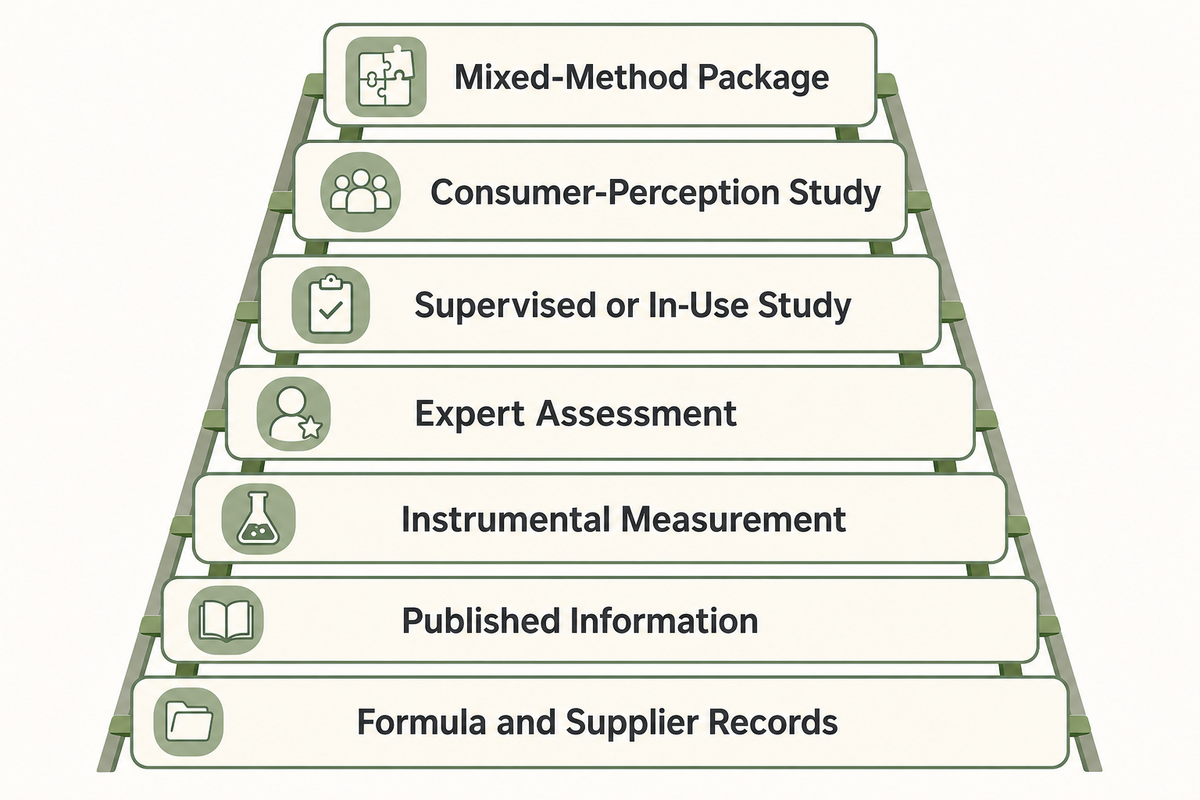
Choose evidence by the proposition being communicated, not by whichever positive report is easiest to obtain. Methods are not automatically interchangeable, but a justified package can combine formula records, literature, instrumental work, expert assessment, supervised use, and consumer perception when the claim genuinely contains those dimensions.
7-Method Claim Support Router
- Formula and supplier records: composition and controlled-input facts.
- Published information: background plausibility and context, not automatic finished-product proof.
- Instrumental measurement: objective physical endpoints under a named method.
- Expert assessment: defined observable endpoints with suitable training and controls.
- Supervised or in-use study: product performance under specified conditions.
- Consumer-perception study: what participants reported using the stated question and scale.
- Mixed-method package: measured and perceived propositions kept distinct but connected.
At every rung, check the marketed product or justified representative version, population, directions, environment, endpoint, time point, comparator, analysis, and exact words. Ingredient literature can explain plausibility without proving finished-product performance, and a perception percentage cannot be translated into an unmeasured physiological change.
A claims substantiation study should fit the proposition, and claims testing should combine methods only when each result keeps its own meaning. For skin hydration or moisturization, instrumental endpoints and perception language should remain distinct. Independent consumer surveys or consumer home use tests can address reported experience, but the products being tested, directions, questions, scales, and analysis must match the released wording.
Do
- Start with the exact endpoint.
- Record method and product identity.
- Preserve population and use conditions.
- Combine methods only with a written rationale.
Don’t
- Promote ingredient evidence into a product result.
- Swap subjective and objective outcomes.
- Extend one time point across a duration claim.
- Treat a positive result as automatic wording approval.
Ingredient literature may help a brand substantiate its claims about plausibility, while claim substantiation data from the specific product must carry the performance conclusion. That distinction protects consumer trust by keeping the evidence boundary visible.
Design the Study Around the Intended Wording
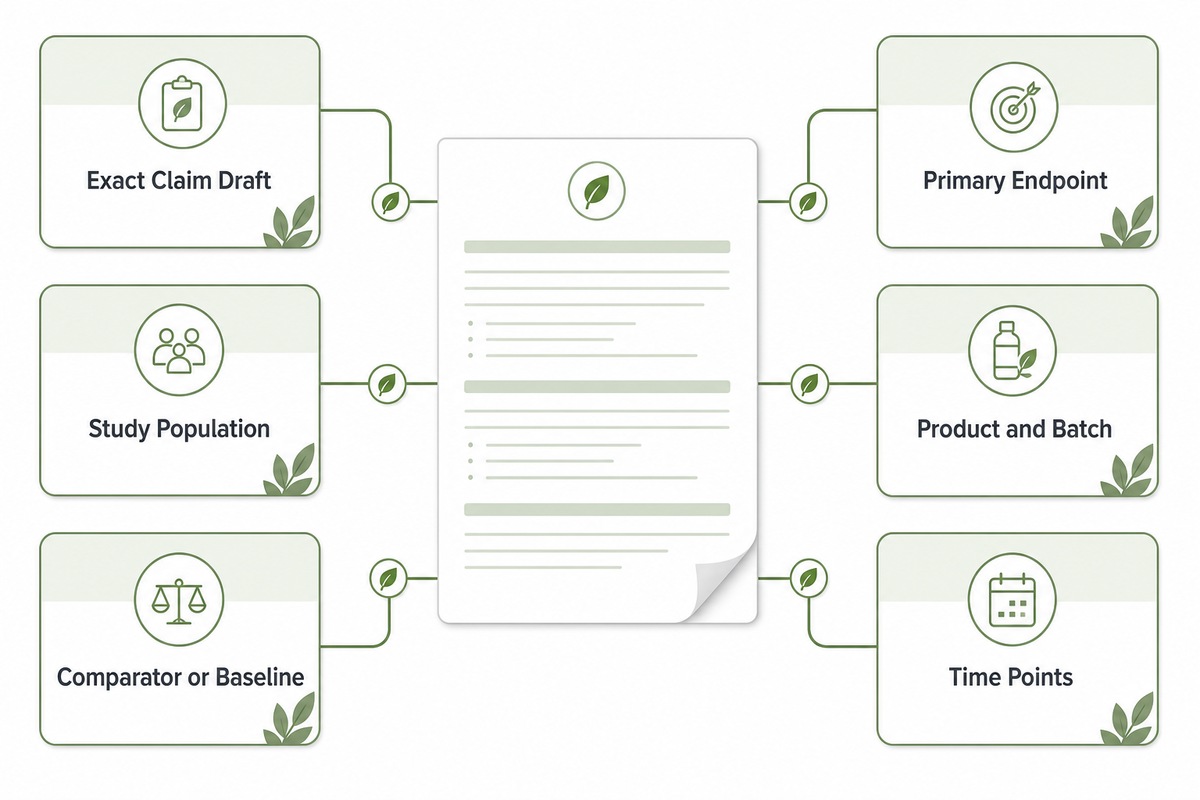
Clinical studies used for substantiation should be designed around the proposed words before data collection begins. A statistically significant result doesn’t by itself validate every consumer-facing interpretation, and there’s no universal sample size, instrument, duration, comparator, or study design for every skincare claim.
20-Field Study Boundary Box
1. Exact claim draft2. Primary endpoint3. Secondary endpoints4. Study population5. Eligibility criteria6. Product and batch7. Directions and dose8. Run-in or washout9. Environment10. Comparator or baseline11. Time points12. Evaluator blinding13. Sample-size rationale14. Missing data15. Multiplicity16. Analysis population17. Statistical plan18. Adverse-event process19. Protocol deviations20. Report owner
Name only the timepoints actually measuredA timepoint field might be formatted as 5 min, 10 min, 15 min, 20 min, 30 min, 45 min, 1 hr, 2 hr, 4 hr, 6 hr, 8 hr, 12 hr, 24 hr, 36 hr, 48 hr, 72 hr, 3 days, 5 days, 7 days, 10 days, 14 days, 21 days, 28 days, 30 days, 60 days, 90 days, 1 week, 2 weeks, 8 weeks, 3 months, 6 months, or 12 months. This is a formatting catalog, not a recommended schedule; the released claim must stay within the protocol and observed result. A generic percentage field might be formatted as 5%, 10%, 25%, 50%, 75%, 90%, or 95%; these are display examples, not study results or claim recommendations.
As a best practice, a time-bound claim needs the relevant time point, a comparative claim requires a justified comparator, and a claim tied to normal use shouldn’t rely on improbable application conditions. Direct product-stability questions to the separate guide on cosmetic stability testing evidence; stability is one evidentiary pathway, not a substitute for claim-specific performance support.
Cosmetic scientists and other qualified specialists can help define endpoints and analysis before enrollment. A human repeat insult patch test is a named protocol, not automatic support for every safety, tolerance, allergy, or performance statement.
Independence is part of the fileRecord who designs, conducts, analyzes, and approves the study. Third-party involvement can strengthen separation of interests, but it can’t repair a protocol that measured the wrong product, endpoint, population, comparator, or time point.
Translate Results Without Overstatement
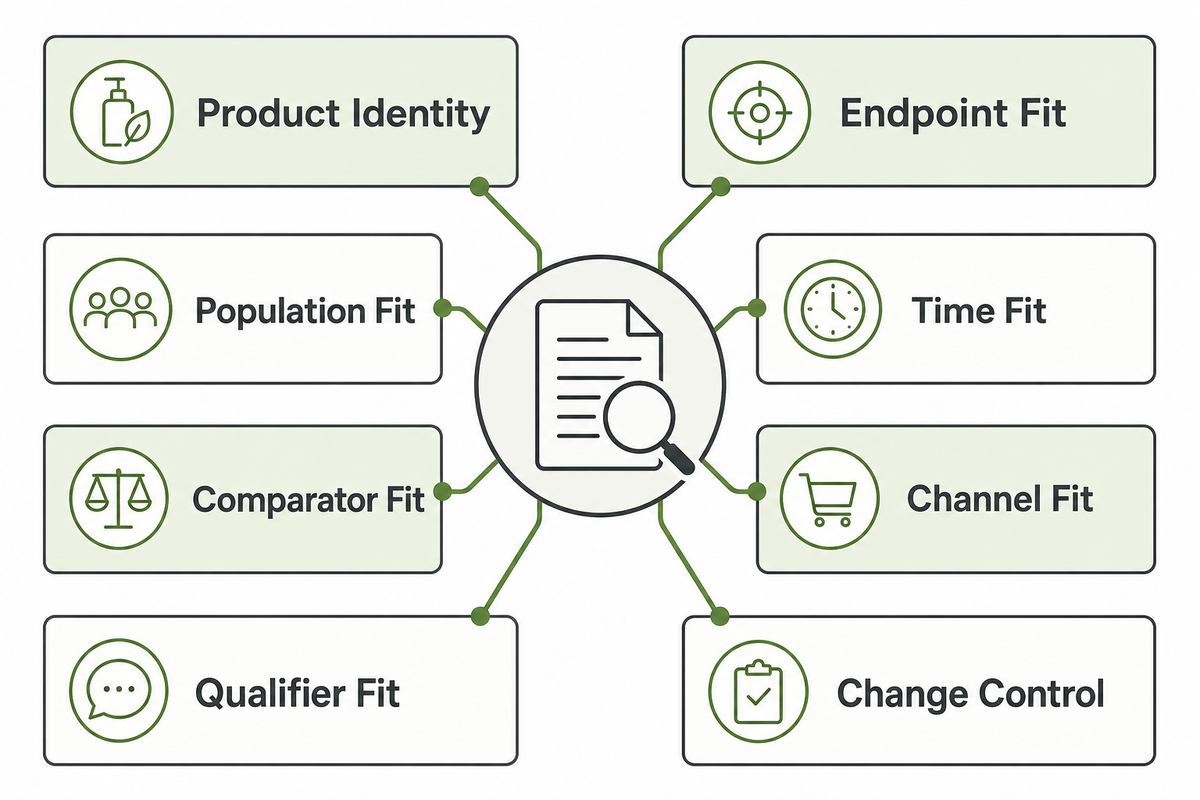
Results should change the words, not merely fill a presentation slide. Separate the measured endpoint, direction, magnitude, uncertainty, analysis population, time point, use conditions, participant-reported outcome, practical meaning, limitations, subgroup status, and final wording before a claim is approved.
| Result state | Copy decision | Required record | Stop condition |
|---|---|---|---|
| Direct fit | Release the tested wording with its material conditions. | Endpoint, magnitude, population, product, time, and analysis. | Creative changes the takeaway. |
| Narrower support | Narrow or qualify the claim. | Exact limitation and approved qualifier. | Qualifier contradicts the headline. |
| Inconclusive | Hold, analyze, or collect additional evidence. | Missing data, deviations, uncertainty, and next decision. | Commercial wording outruns the result. |
| Mismatch | Remove, redesign, or retest the claim. | Why product, method, comparator, endpoint, or context did not fit. | A nearby positive result is substituted. |
| Audit field | Evidence question | Copy action |
|---|---|---|
| Product identity | Was the released product or justified representative version studied? | Bind the copy to the supported version. |
| Endpoint fit | Does the endpoint measure the promised change? | Narrow or remove an unsupported meaning. |
| Population fit | Does the study population match the intended audience? | Qualify the audience where needed. |
| Time fit | Was the claimed time point actually measured? | Name only the supported timing. |
| Comparator fit | Was the stated comparison defined and tested? | Remove or narrow an unmatched comparison. |
| Channel fit | Does the complete execution preserve the approved takeaway? | Review each channel version. |
| Qualifier fit | Is the limitation clear and close to the claim? | Revise a contradictory qualifier. |
| Change control | Did a material product or execution input change? | Reopen and document reassessment. |
Keep phrases such as “on average,” “among participants,” or “after four weeks under study conditions” if they materially change meaning. For consumer percentages, preserve the question, scale, base, timing, and population; for before-and-after photos, retain selection, lighting, camera, angle, expression, use, timing, retouching, and representativeness.
Product-version checkA Federal Trade Commission skincare case summary described cited research that didn’t test the advertised product or even an ingredient. A study can be methodologically real yet still fail the released claim because the product, magnitude, context, or takeaway doesn’t match.
Build a Claim-to-Copy Release Packet
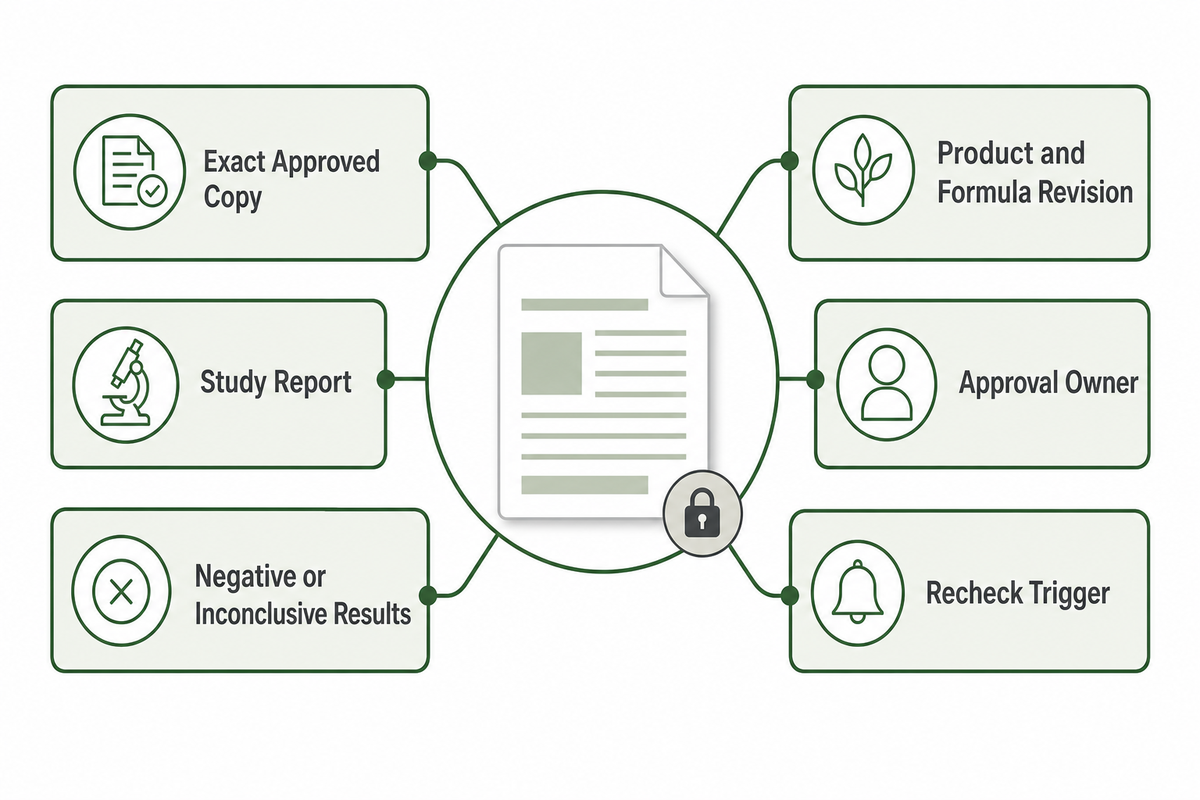
A laboratory report stored somewhere is not a complete substantiation dossier. The release record should connect the approved copy to the tested product, protocol, data, analysis, limitations, creative, ownership, first dissemination date, and events that reopen review.
20-Field Claim-to-Copy Release Packet
Claim identifierExact approved copyLikely takeawayProduct and formula revisionMarkets and channelsProtocolStudy reportRaw-data location and ownerAnalysis summaryLiterature or ingredient supportImages and creative executionQualifiersNegative or inconclusive resultsDeviationsConflicts of interestProfessional reviewsApproval ownerRelease dateRecheck triggerSuperseded versions
As an internal governance control, record when the substantiation was possessed, who completed the internal review, and when the claim was first disseminated, and keep missing evidence visible as an open item. For an applicable European Union claim, connect the retained proof of effect to the product information file instead of maintaining an isolated marketing folder that cannot be reconciled with the product record.
ReleaseRelease with qualifierRestrict market or channelRevise and retestRemoveEscalate
Check Packaging, Retail, Social, and Influencer Executions
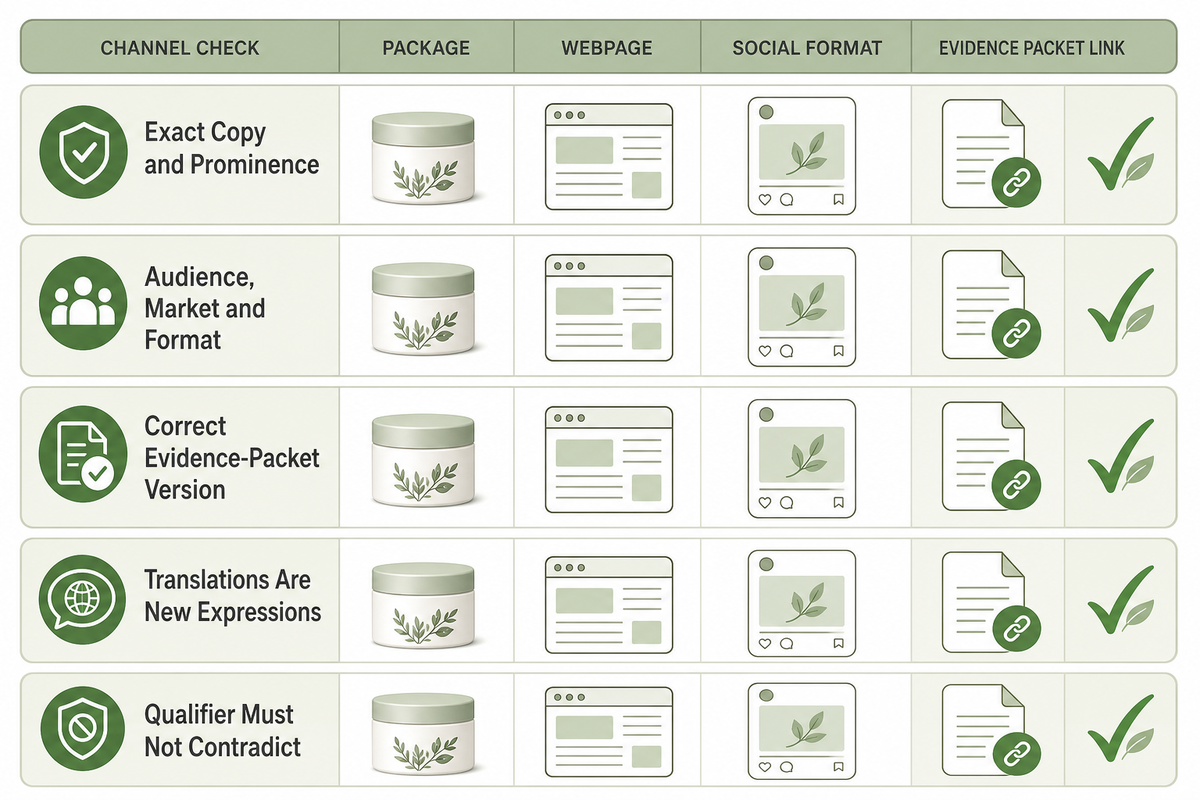
One approval doesn’t automatically cover every format. Match the approved claim to each package panel, product webpage, retailer listing, marketplace ad, search ad, email, social post, paid influencer brief, endorsement, translation, distributor page, sales deck, and before-and-after asset.
Channel execution checklist
- Freeze exact copy, prominence, nearby qualifier, image, and demonstration.
- Record audience, market, language, format limits, implied comparison, and link destination.
- Match each execution to the correct evidence-packet version.
- Treat translations and shortened platform variants as new claim expressions.
- Confirm that a qualifier clarifies rather than contradicts the main message.
For United States reviews and endorsements, add the material connection, testimonial typicality or qualification, creator training, monitoring, altered or incentivized review handling, and corrective-action owner. The Federal Trade Commission endorsement resources explain that brands, endorsers, and intermediaries can each have responsibilities; a platform disclosure tool isn’t a substitute for reviewing the execution.
A statement that is accurate in isolation can still be misleading to the consumer when the full image, qualifier, testimonial, or placement changes the takeaway.
Monitor after launchThe release packet controls the approved version, but creator networks, reviews, retailer edits, translations, and image crops can change the live takeaway. Assign monitoring frequency, evidence capture, correction authority, and escalation before the campaign starts.
Recheck Substantiation After Material Changes
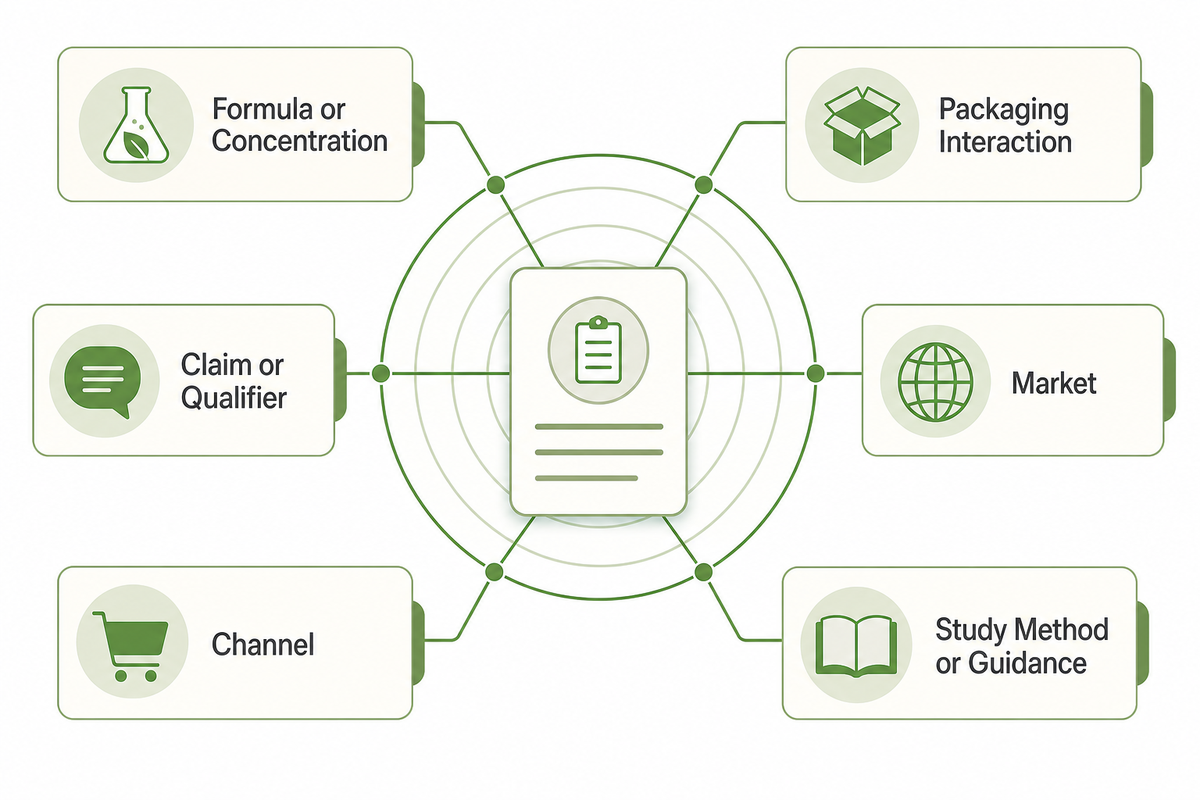
As an evidence-governance practice, treat a material change as a prompt for documented reassessment; this isn’t a universal legal rule and doesn’t mean every change requires the same new study. Compare the changed product, endpoint, claim, use, consumer, market, language, channel, and creative with the exact boundaries of the existing evidence, then record the decision and its owner.
17-Condition Evidence Recheck Index
Formula or concentrationRaw-material supplierRaw-material specificationManufacturing processProduct batchPackaging interactionDispensingDirections or doseClaim or qualifierComparisonTarget consumerMarketLanguageChannelVisual executionStudy method or guidanceAdverse experience or complaint trend
Choose among documented no impact, administrative update, evidence bridge with justification, additional analysis, targeted confirmation, new study, claim removal, or escalation. A formula-to-pack change can be routed to the existing guide on formula-to-pack compatibility evidence rather than stretched into a general claim rule.
Localization changes meaningA market or language change needs a fresh consumer-takeaway review because social, cultural, linguistic, audience, and execution context can change what the claim communicates without changing the base sentence. Don’t prescribe an automatic retest interval; follow materiality to the product, endpoint, claim, use, and market.
Hand a Clear Claim Brief to a White-Label Skincare Partner
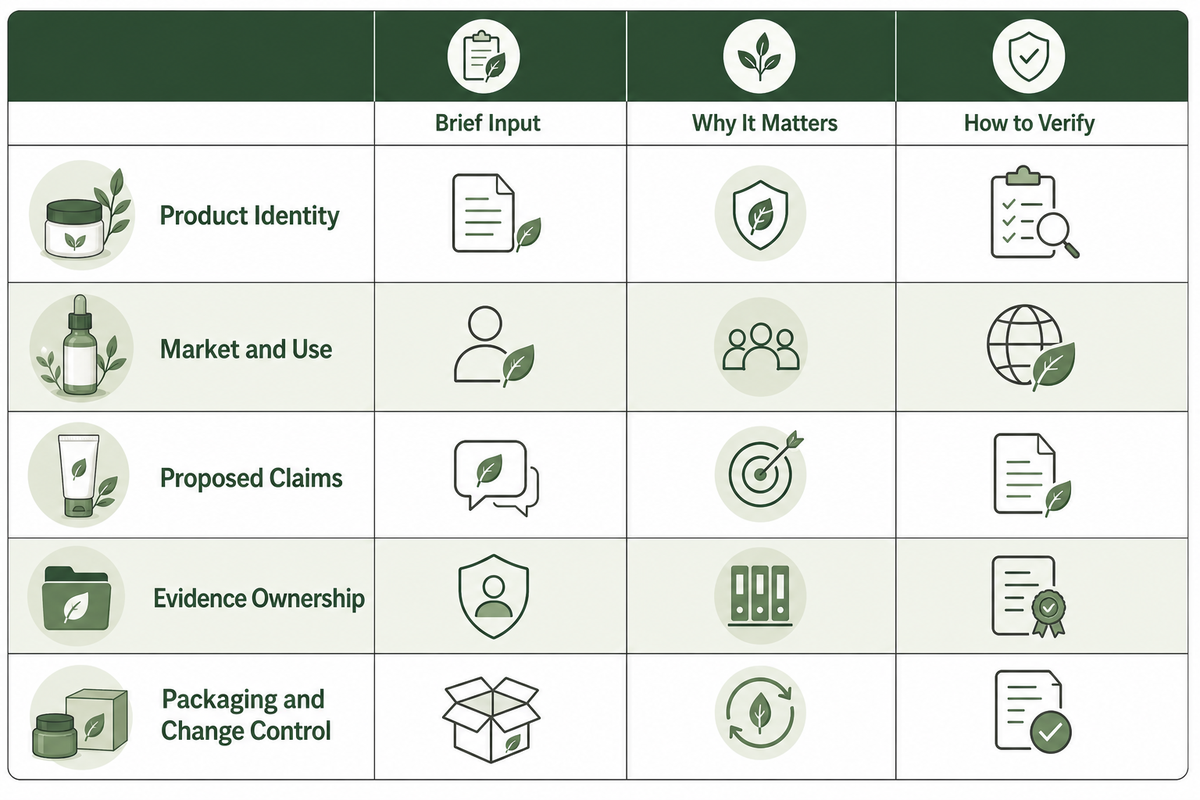
A manufacturing discussion works better when product development and evidence planning use the same product version, packaging, market, and proposed words. Choosing an established formula doesn’t make every ingredient, supplier, or category claim automatically transferable to the finished product.
NEXO context, kept within the supplied factsAccording to NEXO’s supplied brand profile, NEXO Beauty Labs is a global cosmetic original-equipment and original-design manufacturing partner specializing in skincare, hair care, and body care development, formulation innovation, and scalable manufacturing. Its manufacturing foundation dates to 1999, with more than 25 years of manufacturing expertise, and its international team has supported global partners since 2020.
Prepare the product route, formula revision, target users and use, destination markets, exact proposed claims, claim owner, available evidence, gaps, study owner, packaging, label and channel plan, change-notice duty, final approver, and unresolved regulatory questions. This keeps the skincare product development process aligned with evidence ownership without shifting legal responsibility by assumption.
Project brief checklist — copy these into your manufacturer discussion:
| Parameter | Required input | Why it matters | How to verify |
|---|---|---|---|
| Product identity | Route, formula revision, batch status | Binds evidence to the represented product | Controlled brief and version record |
| Market and use | Countries, audience, directions, dose | Controls classification and takeaway | Market-specific professional review |
| Proposed claims | Exact words, qualifiers, visuals, channels | Defines the evidence target | Claim Language Breakdown Card |
| Evidence ownership | Files, gaps, study owner, approver | Prevents silent responsibility transfer | Named owners and release packet |
| Packaging and change control | Pack, dispensing, notice triggers | Keeps the tested configuration visible | Specifications and change record |
Once claim language, evidence ownership, formula route, packaging, and target markets are visible, buyers can align those inputs with the NEXO white-label skincare project pathway. This link is a manufacturing handoff, not a statement that NEXO provides independent claim testing, legal review, regulatory approval, guaranteed acceptance, or any unverified certification, minimum order, price, lead time, capacity, or outcome.
Bring one claim brief into the product discussionCombine the product route, target markets, proposed claims, packaging, evidence ownership, and open questions, then open a project discussion with NEXO Beauty Labs.
Frequently Asked Questions
What is claim substantiation?
Claim substantiation is the documented evidence and reasoning that support what consumers are likely to understand from a product statement before it is used. For skincare, the record connects exact wording, product and formula version, target market, audience, channel, visuals, qualifiers, evidence method, results, limitations, and approval owner. It is not simply a positive laboratory report.
How much evidence is enough to support a cosmetic claim?
There is no universal number of studies, participants, instruments, or pages that makes every cosmetic claim adequately supported. The answer depends on specificity, likely consumer takeaway, product, market, consequence of error, existing knowledge, study quality, and what qualified experts consider appropriate. A narrow perception claim may need a different package from a numerical, comparative, safety, duration, or physiological-performance claim, so record the reasoning and obtain market-specific professional review.
What types of evidence are required to substantiate each type of claim?
Evidence should match the proposition. Composition statements may rely on controlled formula and supplier records; objective performance claims may call for instrumental or expert-assessed endpoints; subjective experience claims may use well-designed consumer-perception work; comparative or time-bound claims require the relevant comparator and time point; mixed claims may need more than one method. Ingredient literature can explain plausibility but does not automatically prove finished-product performance.
Is the product a cosmetic, a drug, or both?
In the United States, classification depends on intended use, which can be shown by claims, promotional context, and how the product is presented, not only by physical form. Cleansing, beautifying, or appearance claims may remain cosmetic, while disease-treatment or body-structure or function claims can introduce drug regulation or a combined position.
Review the product name, directions, testimonials, imagery, website, marketplace listing, influencer instructions, and current Food and Drug Administration guidance before designing the study or publishing the claim. Record unresolved questions and send them to qualified market-specific counsel or regulatory professionals; neither a positive report nor the absence of general cosmetic premarket approval grants permission to use therapeutic language.
What is the first practical step to improve claims substantiation?
Freeze one exact proposed claim and complete the 16-Field Claim Language Breakdown Card before choosing a test. Identify the likely consumer takeaway, product and formula revision, target market, audience, channel, image or comparison, time point, qualifier, and evidence owner. This exposes ambiguity early, makes laboratory or adviser briefs comparable, and prevents a weak evidence package from being stretched to support copy that was never part of the study plan.
Make the claim no broader than the evidenceUse the nine-step workflow to connect the exact wording, product, study, result, creative, approval, and recheck trigger. When the project brief is ready, contact NEXO Beauty Labs.
References and Sources
- United States Federal Trade Commission, Advertising Substantiation Policy Statement
- United States Federal Trade Commission, Health Products Compliance Guidance
- United States Federal Trade Commission, L’Oréal Scientific Claims Case Summary
- United States Federal Trade Commission, Endorsements, Influencers, and Reviews
- United States Food and Drug Administration, Is It a Cosmetic, a Drug, or Both?
- EUR-Lex, Commission Regulation (EU) No 655/2013
- EUR-Lex, Regulation (EC) No 1223/2009
- European Commission, Cosmetics Legislation
- Cosmetic, Toiletry and Perfumery Association, Cosmetic Product Claims
- TRI Princeton claims-testing service provider, Planning and Designing Claims Substantiation Tests
- The Benchmarking Company guest article hosted by BBB National Programs, Beauty Product Claims
- Dermatological Reviews, The Science Behind the Label
Why beauty brands work with NEXO
About NEXO Beauty Labs Manufacturing Support
NEXO Beauty Labs supports skincare, body care, sun care, hair care, and private label brands with formulation, sampling, filling, quality control, and export-ready launch support.
Project Review Before RFQ
Before quotation, we help clarify product category, active direction, formula stage, package choice, compliance market, MOQ, sampling schedule, and required documents.
Request a Cosmetic QuoteCompany Profile // Data Sheet
CompanyNEXO Beauty Labs
Business TypeCosmetic OEM / ODM manufacturing partner
Main ProductsPrivate label skincare, facial serums, moisturizers, cleansers, sunscreen, body care, and hair care products
Manufacturing CapabilityFormula development, sample adjustment, package sourcing, filling, QA/QC, documentation, and export support
RFQ Data NeededProduct type, formula goal, package format, target market, MOQ, claims, timeline, and benchmark samples
Websitenexobeautylabs.com