Get in touch with NEXO Beauty Labs Company

Last updated: October 2026
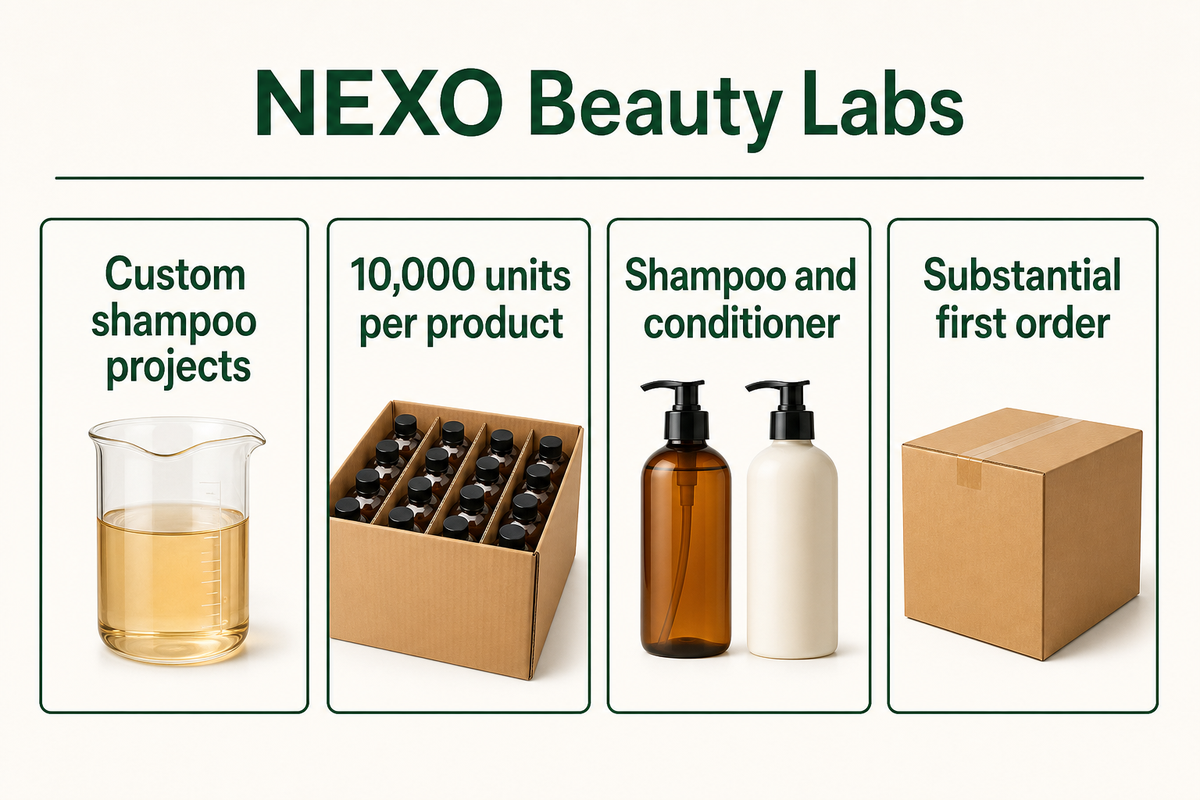
The best shampoo manufacturers depend on your launch: Pravada suits small ready-formula orders, HSA Cosmetics offers Italian bulk or finished supply, and Twincraft develops liquid and bar formats. NEXO Beauty Labs fits brands able to commit to 10,000 units per product for a custom shampoo program.
An MOQ makes sense only with its formula route, specific packaging and a unit of measure. A supplier shipping 50 bottles of an existing shampoo solves a different problem from a factory making a formula around a 5,000-piece order. This report identifies and compares those differences across 20 manufacturers, enabling a brand team to shortlist the suppliers who can help with the work they actually need done.
Quick picks
- Best for custom shampoo projects from 10,000 units per product: NEXO Beauty Labs
- Best for Italian bulk or finished shampoo supply: HSA Cosmetics
- Best for a small ready-to-brand launch: Pravada
- Best for Australian salon-owned ranges: Private Label Dynamics
- Best for UK bulk supply with a self-filling option: John Drury
- Best for exploring liquid shampoo and shampoo bars: Twincraft
Disclosure: This guide is published by NEXO Beauty Labs. We list ourselves first because this is our website, not because we claim to be the market leader. The other 19 manufacturers are grouped by what they’re best for, in no particular order within each group.
How We Selected These Shampoo Manufacturers
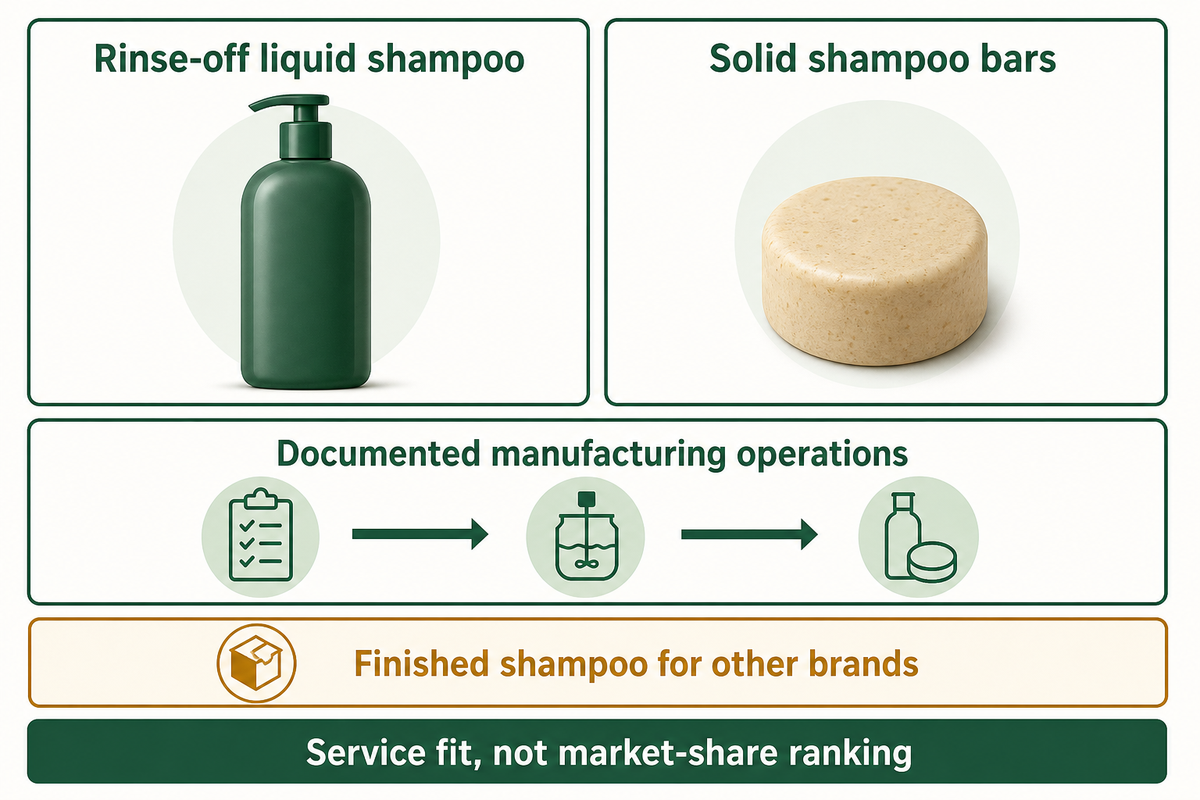
To identify firms capable of producing finished shampoo for other brands, we searched for documented manufacturing operations and clear offers to develop or produce finished shampoo for other brands. Firm information was verified against official company websites and public sources in October 2026. We excluded trading companies, distributors, sourcing platforms, directories, media websites, used equipment dealers, ingredient suppliers, packaging-only businesses, and consumer brands that do not have a contract manufacturing offer.
The comparison is restricted to rinse-off liquid shampoo and solid shampoo bars for cosmetic cleansing. It excludes medicated products, pet shampoo and aerosol dry-shampoo specialists. The shortlist is neither exhaustive nor a market-share ranking: group placement reflects service fit, while the order within each group carries no performance score.
Published figures retain their original scope. A whole-factory output figure doesn’t become shampoo capacity, and an order minimum says nothing about the maximum a manufacturer can produce. Founding dates refer to company histories; NEXO’s manufacturing foundation and Twincraft’s stated opening are explained in their cards. Where a source identifies a production or contact base rather than a separate corporate headquarters, we preserve that distinction.
Shampoo Manufacturers Compared
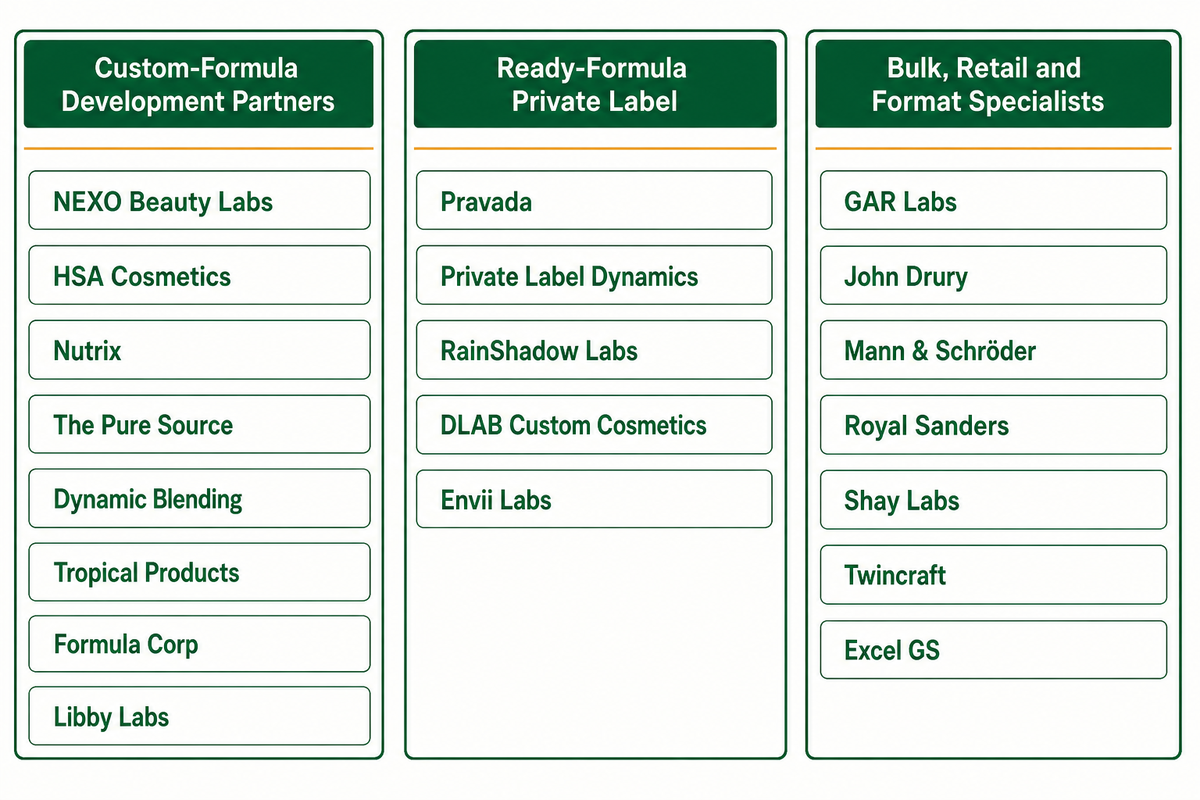
Use the table to narrow the service model first. The company cards below explain order thresholds, capabilities and limitations in more detail. “Custom” describes development work; it doesn’t, by itself, promise that formula ownership or exclusivity transfers to the buyer. Dates shown for NEXO, Formula Corp, GAR Labs and Twincraft have source qualifications in their respective profiles.
| No. | Company Name | Headquarters | Founded Year | Best For | Brief Introduction | Shampoo Programs | Key Advantages | Potential Disadvantages | Official Website |
|---|---|---|---|---|---|---|---|---|---|
| 1 | NEXO Beauty Labs | Guangzhou, China | 1999 manufacturing foundation; 2020 international division | Custom shampoo brands ready for 10,000 units per product | International division with a stated Chinese manufacturing foundation and shampoo development offer. | Custom repair-appearance, scalp-balance, hydrating and botanical formulas | Coordinated shampoo and conditioner development | Standard 10,000-unit commitment per product is substantial for untested demand. | nexobeautylabs.com |
| 2 | HSA Cosmetics | Milano, Italy; registered headquarters | 1982 | Italian bulk supply or finished private label shampoo | Hair-care and color producer manufacturing in Bisuschio. | Bulk batches or full-service finished shampoo | Five laboratories and internal regulatory-affairs support | Finished orders start at 5,000 pieces; bulk uses separate kilogram thresholds. | www.hsacosmetics.com |
| 3 | Nutrix | Salt Lake City, USA; manufacturing base | Not publicly disclosed | Ready bases with laboratory adaptation | US personal-care contract manufacturer with stock and development routes. | Basic Shampoo, adapted bases and custom development | Formulation through filling, packaging and logistics | Stock availability does not extend automatically to a newly developed formula. | www.nutrixusa.com |
| 4 | The Pure Source | Miami, USA | 1995 | US custom orders of 5,000 units per product | Miami manufacturer with a dedicated custom shampoo service. | Custom liquid shampoo | Dedicated shampoo offer from its Miami facility | Each product carries a 5,000-unit entry minimum. | www.thepuresource.com |
| 5 | Dynamic Blending | Vineyard, USA | 2015 | Development with packaging and launch services | Turnkey contract producer combining laboratory and manufacturing functions. | Shampoo, conditioner and associated hair-care development | Branding, package sourcing and fulfillment alongside production | Aerosol briefs fall outside its stated offer. | dynamicblending.com |
| 6 | Tropical Products | Salem, USA | Not publicly disclosed | Liquid shampoo across retail and tote formats | Liquid-product manufacturer working with stock, custom and customer formulas. | Stock, new or existing-formula shampoo | Published filling span of 1 ounce to 275 gallons | Sub-ounce trial packs sit outside the advertised filling range. | www.tropicalproducts.com |
| 7 | Formula Corp | Auburn, USA | 1983 | Water-based liquid mixing and packaging | Contract producer whose published manufacturing scope specifically names shampoo. | Water-based shampoo and conditioner | Shampoo included in published ISO 22716 scope | Published scope addresses liquid or pasty water-based cosmetics. | formulacorp.com |
| 8 | Libby Labs | Berkeley, USA | 1959 | Client formulas with buyer-managed packaging | Formulation, blending and filling business accepting existing customer formulas. | Custom or client-supplied shampoo formulas | Existing-formula production; filling from 1,000 units | Packaging procurement and label design remain the buyer’s responsibilities. | www.libbylabs.com |
| 9 | Pravada | Fort Myers, USA | 2009 | Small ready-to-brand shampoo launches | Private-label producer offering separate ready-formula and bespoke development paths. | Ready formulas; fully custom development | Entry route from 50+ pieces per stock-keeping unit | Fully bespoke formulas start at 2,500+ pieces per stock-keeping unit. | www.pravadaprivatelabel.com |
| 10 | Private Label Dynamics | Sunshine Coast, Australia | 2012 | Salon professionals building an Australian range | Australian manufacturer serving professional hair-industry buyers. | Moisture, Peppermint and Purple Shampoo | Named salon shampoo options from in-house manufacturing | Sales are restricted to industry professionals. | www.privatelabeldynamics.com |
| 11 | RainShadow Labs | St. Helens, USA | 1983 | Bulk stock or custom formula purchasing | Personal-care manufacturer with separate stock and custom bulk routes. | Stock shampoo and custom formulations | Distinct 10-gallon stock and 25-gallon custom thresholds | Buyer arranges packaging; custom minimum applies per formula. | www.rainshadowlabs.com |
| 12 | DLAB Custom Cosmetics | Porto, Portugal; office and production | Not publicly disclosed | Online shampoo orders from 100 units | Cosmetics manufacturer offering listed products through an online customization route. | Listed shampoo; advanced project customization | 100-unit entry for listed online options | Advanced customization starts at 500 units and may require more. | dlabcosmetics.com |
| 13 | Envii Labs | Spring, USA | 2016 | Ready shampoo with fragrance choices | In-house formulator and packager offering Daily Cleansing Shampoo. | Listed daily shampoo; separate development consultation | 60-bottle product minimum with scent and pack options | The small-order threshold belongs to the listed shampoo, not bespoke development. | enviilabs.com |
| 14 | GAR Labs | Riverside, USA | 1982 | US filled orders or bulk hair-care supply | Contract hair and skin care producer serving established order volumes. | Traditional and natural shampoo formulations | Mixing, hot/cold filling and packaging services | 5,000 pieces or 110 gallons per product; customer pays freight. | www.garlabs.com |
| 15 | John Drury | Brighouse, UK; contact and manufacturing base | 1882 | UK filled packs or self-filling supply | Soap and liquid-care manufacturer offering shampoo in bulk or finished containers. | Shampoo and conditioner; IBC supply | Retail packs and intermediate bulk containers available | Published shampoo minimum is 1,000 litres. | www.john-drury.co.uk |
| 16 | Mann & Schröder | Siegelsbach, Germany | 1951 | Drugstore, discount and grocery private labels | Family-owned group with a dedicated private-label cosmetics division. | Shampoo within broader retail hair-care ranges | Two German production sites; retail-focused product development | German manufacture does not satisfy another country’s domestic-production requirement. | www.mann-schroeder.de |
| 17 | Royal Sanders | Vlijmen, Netherlands | 1851 | European multi-category personal-care programs | European manufacturing group offering shampoo alongside other personal-care categories. | Shampoo and conditioner within a broad portfolio | Seven-factory European manufacturing footprint | Listed factories do not provide North American or Asian domestic manufacture. | royalsanders.com |
| 18 | Shay Labs | Woodstock, USA | Not publicly disclosed | Moving developed formulas into US production | Hair-care developer and manufacturer supporting formulation transfer and scale-up. | Formula creation, transfer and production | Direct manufacturing and a separate qualifying pilot route | 500-unit pilot access is conditional; usual direct production starts at 5,000 units. | shaylabs.com |
| 19 | Twincraft | Williston, USA | 1972 | Liquid shampoo and shampoo-bar development | Contract personal-care manufacturer publishing liquid and solid development concepts. | Reset Shampoo and Purple Shampoo Bar concepts | Liquid and solid formulation development experience | Its described shampoo-bar solution uses a thin plastic moisture-barrier film. | www.twincraft.com |
| 20 | Excel GS | Daventry, UK | 1992 | Hair-care wholesale and hospitality wet products | Contract manufacturer combining on-site chemistry and wet-product filling. | Shampoo and conditioner manufacturing | On-site chemistry; published 50–3,000 kg batch range | Published filling range starts at 20 ml; smaller sample packs fall outside that range. | www.excel-gs.co.uk |
Custom-Formula Development Partners
These firms can develop or adapt formulas alongside manufacturing. The practical distinction is the starting point: an existing base, a buyer-owned formula, or a new brief. Some also sell ready products, but their relevance here is the ability to connect formulation work with mixing, filling or packaging. Not all private label shampoo manufacturers make these services part of the same quotation.
1. NEXO Beauty Labs: Best for custom shampoo brands ready for 10,000 units per product
Headquarters: Guangzhou, China · Founded: Manufacturing foundation since 1999; international division since 2020 · Type: Contract manufacturer; according to its About page, the international division of Xindalu International Biotechnology (Guangzhou) Co., Ltd.
Official website: nexobeautylabs.com
Main products: Repair-appearance, scalp-balance, hydrating and botanical shampoo; conditioner. Published Order Model: Standard 10,000 units per product for custom shampoo.
Certifications / notable work: The shampoo page names Guangzhou Opseve Cosmetics Co., Ltd. as holder of ISO 22716:2007 certificate SZ2503C3 and GMPC SZ2503C4. The named certificate holder is Guangzhou Opseve.
NEXO’s shampoo manufacturing program connects formula development with packaging for brands already able to support the stated order commitment. Coordinated shampoo and conditioner development gives the product team a way to work on cleansing and after-wash feel together. Its listed formula directions describe cosmetic appearance and cleansing goals, rather than treatment promises. The purchasing limitation is the standard 10,000-unit minimum for each product: project-specific evaluation isn’t a guarantee of a smaller first order.
2. HSA Cosmetics: Best for Italian bulk or finished shampoo programs
Headquarters: Milano, Italy, registered headquarters; manufacturing in Bisuschio · Founded: 1982 · Type: Private label hair-care and hair-color manufacturer.
Official website: www.hsacosmetics.com
Main products: Shampoo, conditioner, masks, styling products and hair color. Published Order Model: Finished shampoo from 5,000 pieces, depending on product and packaging; bulk hair care from 500/1,000 kg, depending on product.
Certifications / notable work: ISO 9001 and ISO 22716 certificates name H.S.A. Hair Styling Applications S.p.A., with registered-office and production-site scopes distinguished.
Five laboratories and an internal regulatory-affairs service support HSA’s development offer, according to its website. A brand with its own filling arrangement can consider bulk supply, while a team seeking finished goods can use the full-service route covering filling and packaging. That makes HSA relevant to two different operating models without assuming they share the same minimum order. The limitation for a small packaged launch is the published 5,000-piece starting point; the kilogram figures belong to a separate bulk offer and can’t be read as bottle counts.
3. Nutrix: Best for ready shampoo bases with in-house formulation support
Headquarters: Salt Lake City, Utah, USA, manufacturing base · Founded: Not publicly disclosed · Type: Private-label and contract manufacturer of personal-care products.
Official website: www.nutrixusa.com
Main products: Shampoos, conditioners, skincare, body care and oral care. Published Order Model: Ready Basic Shampoo or laboratory development; no universal shampoo quantity stated.
Certifications / notable work: The company states NSF ISO 9001 and SGS 22716 certification; its FDA registration statement is separate from those certifications.
Nutrix offers a Basic Shampoo that can be paired with Basic Conditioner or adapted through its laboratory, giving a new hair care brand a defined starting point for product development. The manufacturing service extends through filling, packaging and logistics, which may suit a team without those functions in-house. Its natural and organic shampoo offer adds formulation directions, but the exact finished-product claim still belongs to the selected formula. Immediate-shipment stock options are the practical limit of the shortcut: a unique formula is a separate development project, with its own work and timing.
4. The Pure Source: Best for US custom shampoo orders from 5,000 units
Headquarters: Miami, Florida, USA · Founded: 1995 · Type: Custom contract manufacturer of personal-care and shampoo products.
Official website: www.thepuresource.com
Main products: Custom shampoo. Published Order Model: 5,000 units per product from its Miami manufacturing facility.
Certifications / notable work: Its About page describes a UL cGMP facility and QAI organic manufacturing qualification; the qualification doesn’t make every finished shampoo an organic-certified product.
The Pure Source presents a dedicated custom shampoo manufacturing service, making the offer more specific than a general statement that a factory makes cosmetics. A brand developing a US-made liquid shampoo can therefore assess a defined product service alongside a published per-product order threshold. The Miami base and stated manufacturing scope are useful for a team that wants development and production centered in the United States. Its limitation is straightforward: a 5,000-unit minimum applies to each product, so an assortment of several formulas creates a larger inventory commitment than one hero shampoo at the same threshold.
5. Dynamic Blending: Best for formulation, packaging and launch support together
Headquarters: Vineyard, Utah, USA · Founded: 2015 · Type: Turnkey contract manufacturer.
Official website: dynamicblending.com
Main products: Shampoo, conditioner, hair masks, hair serums and hair oils. Published Order Model: Project-based development and manufacturing; no universal shampoo minimum stated.
Certifications / notable work: The official FAQ lists ISO 9001, USDA Organic, NSF/ANSI 305, Kosher and Halal; it discusses FDA registration separately.
In-house research and manufacturing operate in the same facility, according to Dynamic Blending, while its broader offer includes branding, package sourcing and fulfillment support. This combination fits a product team that needs more than bulk liquid and wants several launch tasks handled within one project. The appeal is the service coverage, not an assumption that every optional activity is included in a base price or that every formula carries every listed certification. A clear format limitation appears in its FAQ: aerosols are excluded, so the documented service doesn’t fit an aerosol dry-shampoo brief.
6. Tropical Products: Best for liquid shampoo in retail packs or bulk totes
Headquarters: Salem, Massachusetts, USA · Founded: Not publicly disclosed · Type: Private label shampoo and liquid-product manufacturer.
Official website: www.tropicalproducts.com
Main products: Shampoo and other liquid personal-care products. Published Order Model: Stock, custom or customer-provided formulas; published filling range from 1-ounce packs to 275-gallon totes.
Certifications / notable work: The introduction describes a USDA Organic Certified facility and cGMP operation; FDA/EPA registrations are registration claims, not product approvals.
Tropical Products offers a 50,000-square-foot manufacturing facility in its shampoo presentation, alongside several routes into liquid production. The ability to work from a stock formula, a new brief or an existing customer formula makes the starting material more flexible than a single catalog route. Its pack range is useful for a brand considering both retail bottles and bulk distribution, although container sizes aren’t minimum batch sizes. Brands planning trial packs smaller than 1 ounce would need a filling arrangement outside the advertised range.
7. Formula Corp: Best for water-based liquid shampoo mixing and packaging
Headquarters: Auburn, Washington, USA · Founded: 1983, according to the company’s published history · Type: Private-label and contract manufacturer.
Official website: formulacorp.com
Main products: Water-based shampoo, conditioner, body wash, lotion and liquid soaps. Published Order Model: Project quotation for formulation, production and automated liquid filling; no universal shampoo minimum published.
Certifications / notable work: The policy page lists ISO 22716:2007 and ISO 9001:2015; its ISO 22716 scope explicitly names mixing, blending and packaging shampoo.
Formula Corp’s published scope is particularly relevant to a liquid shampoo brief because shampoo appears directly in the manufacturing description. In-house formulation and automated filling connect the formula work to the finished liquid product, rather than leaving the buyer to source a separate packer by default. Its published production scope is focused on liquid or pasty water-based cosmetics, making format an early selection criterion for a shampoo project. Brands specifying solid bars or dry powders would need a production route outside that stated scope.
8. Libby Labs: Best for client formulas with buyer-managed packaging
Headquarters: Berkeley, California, USA · Founded: 1959 · Type: Contract formulation, blending and filling manufacturer.
Official website: www.libbylabs.com
Main products: Shampoo and other personal-care formulas. Published Order Model: Custom or client-supplied formulas, with a 1,000-unit filling minimum.
Certifications / notable work: The company describes cGMP manufacturing practices.
A brand bringing its own formula can use Libby Labs for blending and filling rather than starting again from a manufacturer’s ready-formula library. That division of work is a practical fit for a buyer that already has product development underway and can manage packaging vendors. The 1,000-unit figure refers to filling, so it shouldn’t be treated as a universal quantity for every component or development service. Packaging procurement and label design remain client responsibilities, and the described service excludes warehousing and drop shipping; a team wanting a complete launch-and-fulfillment package would have additional work to arrange.
Ready-Formula Private Label Shampoo Options
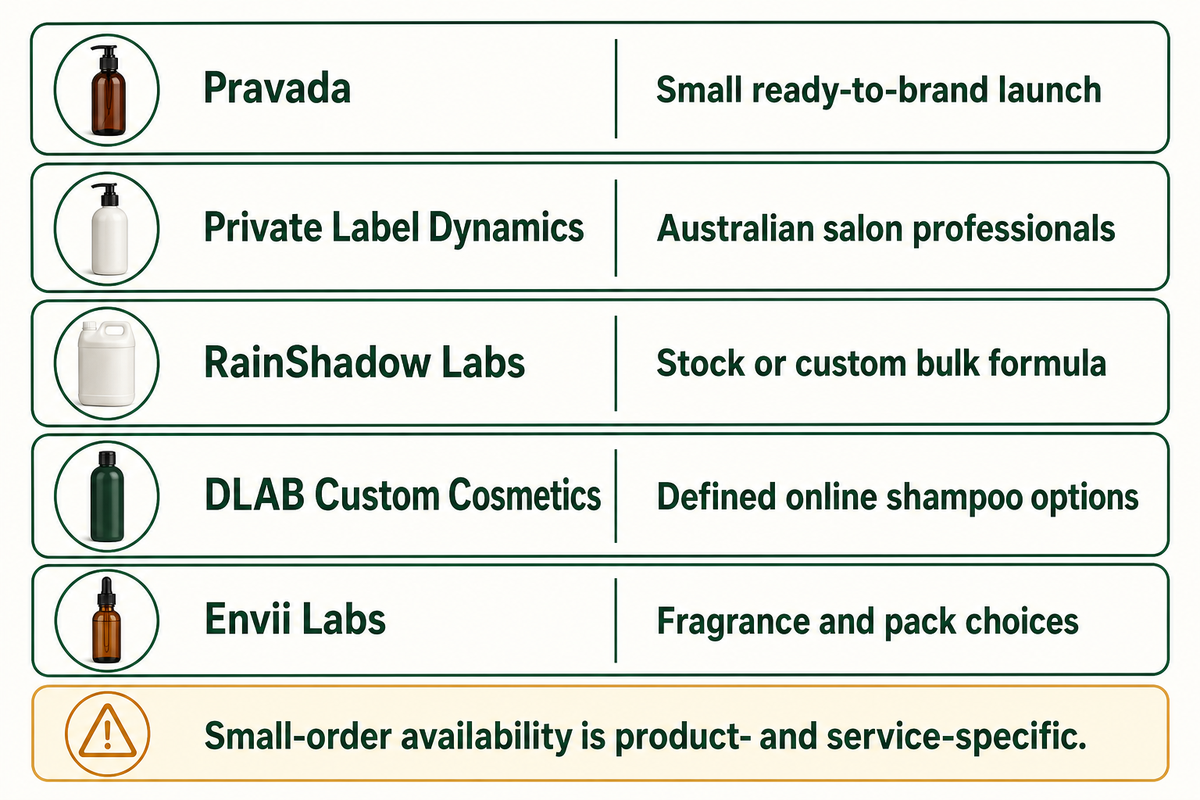
A ready formula can reduce the development needed before an initial order; it also narrows what changes are included. Choices in the initial offerings, such as fragrance or label selection, differ from the extent of modifications in the cleansing system. These private label shampoo products offer useful starting points for new brands to test a range, with published routes allowing new brands to start at different quantities. Availability for small orders belongs to the stated product and service and not to every formula.
9. Pravada: Best for a small ready-to-brand shampoo launch
Headquarters: Fort Myers, Florida, USA · Founded: 2009 · Type: Private-label and custom-formulation manufacturer with in-house mixing and filling.
Official website: www.pravadaprivatelabel.com
Main products: Private-label hair-care and shampoo formulas. Published Order Model: Ready-to-brand products from 50+ pieces per stock-keeping unit; full custom development from 2,500+ pieces per stock-keeping unit.
Certifications / notable work: Company material states ISO 22716/GMP manufacturing; its FDA registration is not FDA certification.
Pravada’s library of more than 300 ready formulas covers its wider range, giving a small brand a catalog-based route before committing to bespoke development. The separation between ready-to-brand and fully custom work makes the choice easy to understand: one starts from an existing product, while the other buys a different development service. A first shampoo line can use the small-entry route without assuming it includes a unique formula. The limitation is the jump in order commitment for that uniqueness: the stated fully bespoke starting quantity is 2,500+ pieces per stock-keeping unit, not the 50+ pieces shown for the ready route.
10. Private Label Dynamics: Best for Australian salon professionals building a range
Headquarters: Sunshine Coast, Australia · Founded: 2012, according to its corporate guide · Type: Australian in-house private-label manufacturer.
Official website: www.privatelabeldynamics.com
Main products: Moisture, Peppermint and Purple Shampoo. Published Order Model: Branded hair-care products for industry professionals; no universal shampoo quantity stated.
Certifications / notable work: The range includes some organic ingredients; that doesn’t establish certified-organic finished shampoo.
Private Label Dynamics pairs its own manufacturing operation with named shampoo options, including a dedicated Purple Shampoo within the haircare range. That makes it a relevant starting point for a salon team developing a retail offer around services it already provides. The ready product selection gives the buyer concrete formulations to consider, rather than requiring a completely new formula at the outset. Its main purchasing restriction is customer eligibility: the company says the offer is limited to industry professionals, so it isn’t an unrestricted entry route for every consumer entrepreneur entering the hair care market.
11. RainShadow Labs: Best for stock or custom shampoo bought in bulk
Headquarters: St. Helens, Oregon, USA · Founded: 1983 · Type: Private-label and custom personal-care manufacturer.
Official website: www.rainshadowlabs.com
Main products: Shampoos and more than 100 hair-care formulations. Published Order Model: Stock formulas from 10 gallons; custom production from 25 gallons per formula; direct-buy products form a separate channel.
Certifications / notable work: Distinct stock and custom bulk programs serve different stages of product development.
RainShadow Labs gives brands a choice between buying an existing bulk formula and commissioning custom shampoo formulations, with different starting quantities for each route. The broader hair-care selection can help a team compare shampoo with related products without treating the whole library as shampoo-only. Because the thresholds are expressed in gallons, the order is a quantity of formula rather than a promised number of retail bottles. The practical limitation combines a 25-gallon minimum for each custom formula with buyer-arranged packaging procurement, which leaves additional coordination for a brand seeking a finished, decorated product.
12. DLAB Custom Cosmetics: Best for online shampoo orders from 100 units
Headquarters: Porto, Portugal, main office and production · Founded: Not publicly disclosed · Type: Private Label and custom cosmetics manufacturer.
Official website: dlabcosmetics.com
Main products: Private-label shampoo. Published Order Model: Listed online shampoo from 100 units; advanced customization from 500 units, with quantities varying by formula, product and packaging.
Certifications / notable work: The site describes GMP production practices.
DLAB’s online shampoo offer is useful when the buyer wants to choose from a defined set of product options and begin with a relatively small order. The 100-unit route is tied to that listed offer, which makes it more concrete than a general promise of flexible minimums. A brand can use the route to work on presentation and selected customization without assuming that every aspect of the underlying formula is open to redesign. Advanced changes move to a separate starting threshold of 500 units and can require more, so the smallest online order isn’t a universal custom-development minimum.
13. Envii Labs: Best for ready shampoo with fragrance and pack choices
Headquarters: Spring, Texas, USA · Founded: 2016 · Type: In-house formulation and packaging manufacturer.
Official website: enviilabs.com
Main products: Daily Cleansing Shampoo. Published Order Model: The listed shampoo starts at 60 bottles, with fragrance choices and bottle, gallon or bulk-pack options.
Certifications / notable work: Daily Cleansing Shampoo is available through a defined small-order program.
Envii Labs is relevant to a small brand that wants a ready daily cleanser with choices in scent and presentation. The named Daily Cleansing Shampoo gives that discussion a specific product basis, while the different pack formats create options for retail or larger-container use. This is private labeling around an existing offer, which can suit a team focused first on branding and customer response. The boundary is the formula route: the 60-bottle threshold belongs to this listed shampoo, while bespoke product development uses a separate consultation service and shouldn’t be priced or scheduled as the same purchase.
Bulk Supply, Retail Programs and Format Specialists
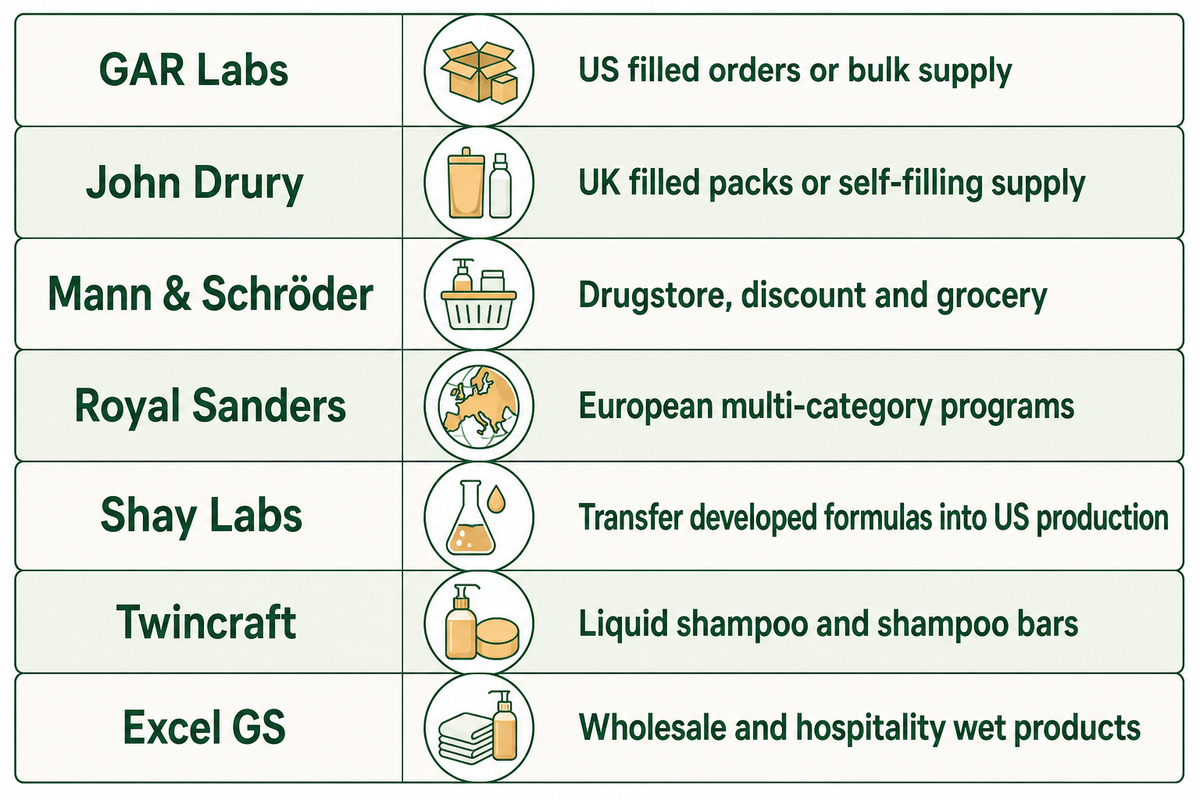
This last group of offerings covers varying purchasing needs, such as bulk liquid and retailer ranges; formula transfers; solid formats and wet-product filling. Hair care products are found within wider portfolios of personal care products. It is not a capacity ranking. A larger published minimum does not prove higher capacity, and a group-wide production figure cannot show how much shampoo capacity is available for a particular buyer. Each fit shown is for the actual service described.
14. GAR Labs: Best for US filled shampoo orders or bulk hair-care supply
Headquarters: Riverside, California, USA · Founded: 1982, reported in a 2008 trade-press factory tour · Type: Contract hair care and skin care manufacturer.
Official website: www.garlabs.com
Main products: Shampoo, conditioners and traditional or natural hair-care formulations. Published Order Model: 5,000 pieces per product; bulk orders separately start at 110 gallons per product.
Certifications / notable work: The official certificate page lists ISO 22716:2007 and ISO 9001:2015.
GAR Labs combines mixing, hot/cold filling and packaging for brands whose order size matches its published qualifying thresholds. The site reports more than 100,000 pieces of combined daily production capacity across products, a whole-operation figure rather than shampoo-only output. A buyer can consider finished units or a separate bulk route, depending on who will handle downstream filling. The limitation is the commitment per product, together with freight that customers arrange and pay from Riverside; combining several formulas into one shipment doesn’t turn the minimum into an assortment-wide allowance.
15. John Drury: Best for UK shampoo in filled packs or self-filling containers
Headquarters: Brighouse, West Yorkshire, UK, company contact and manufacturing base · Founded: 1882 · Type: Contract manufacturer of soap and liquid personal-care products.
Official website: www.john-drury.co.uk
Main products: Shampoo, conditioner, bar soap and liquid soap. Published Order Model: Shampoo-and-conditioner page states a 1,000-litre minimum; filled bottles and jars from 200 ml to 5 L, or IBCs for self-filling.
Certifications / notable work: Its history reports ISO22716 and RSPO certification from 2013, and BRC/RILA for toilet-soap manufacturing.
John Drury offers both finished packaging and intermediate bulk containers, which lets a brand place filling either with the manufacturer or in its own supply chain. Hot and cold mixing and the stated container span make the offer relevant to several liquid pack formats. A team already equipped to fill can consider the IBC route without buying finished retail packs. The purchasing limitation is the published 1,000-litre starting quantity, which remains a liquid-volume requirement regardless of how many bottle sizes the brand hopes to launch.
16. Mann & Schröder: Best for drugstore, discount and grocery private labels
Headquarters: Siegelsbach, Germany · Founded: 1951 · Type: Family-owned cosmetics group; Mann & Schröder Cosmetics is its Private Label division.
Official website: www.mann-schroeder.de
Main products: Shampoo and broader hair and body-care products. Published Order Model: Retail-focused development and production; no universal shampoo order threshold stated.
Certifications / notable work: The quality page lists ISO 22716 and ISO 9001, with IFS/BRC claims differentiated by plant.
Mann & Schröder describes two German production sites and more than 2,000 care products across its business, with private-label work specifically serving drugstores, discount stores and food retailers. That retail focus makes the company relevant to a buyer developing shampoo as part of a broader store-owned assortment. Its portfolio breadth describes category coverage, rather than a count of shampoo formulas or a promise about any one production line. The geographic limitation is clear: all products are made in Germany, so a brief requiring domestic manufacture in another country doesn’t fit that production model.
17. Royal Sanders: Best for European multi-category personal-care programs
Headquarters: Vlijmen, Netherlands · Founded: 1851 · Type: Personal-care products manufacturing group.
Official website: royalsanders.com
Main products: Shampoo, conditioner and other hair, body and personal-care products. Published Order Model: Multi-site European production; no universal shampoo quantity stated.
Certifications / notable work: Its quality page lists ISO 22716, IFS HPC and BRCGS for Koninklijke Sanders BV, rather than automatically for every subsidiary.
Royal Sanders reports seven factories and 675 million units per year across the group’s products, placing shampoo inside a wider beauty and personal care manufacturing offer. The useful buyer fit is coordination across categories, since shampoo and conditioner appear together in its hair-care portfolio. Neither the annual figure nor the factory count identifies available shampoo output for a new contract. All seven listed factories are in Europe, creating a geographic limitation for programs that require manufacture within North America or Asia rather than supply imported from a European production site.
18. Shay Labs: Best for transferring a developed formula into US shampoo production
Headquarters: Woodstock, Illinois, USA · Founded: Not publicly disclosed · Type: Custom hair-care developer and manufacturer.
Official website: shaylabs.com
Main products: Shampoo and hair-care products. Published Order Model: Production-ready direct manufacturing generally starts at 5,000 units; a 500-unit Pilot/Accelerator route has eligibility conditions.
Certifications / notable work: The hair-care page states ISO 22716:2007 certification.
Shay Labs supports formula creation as well as formula transfer, scale-up and production, making it relevant to brands that already have a developed product and need a manufacturing route. Its separate direct-manufacturing and pilot offers recognize different stages of readiness rather than assigning every brief the same small minimum. The 500-unit option depends on the formula, package, components and production requirements, and production is priced separately. For a buyer whose project doesn’t qualify for that route, the practical limitation is the usual 5,000-unit direct-production starting point, rather than an assumed right to a 500-unit commercial run.
19. Twincraft: Best for exploring liquid shampoo and purpose-designed shampoo bars
Headquarters: Williston, Vermont, USA, according to the current contact page · Founded: 1972 opening in Montreal, according to Twincraft · Type: Contract personal-care manufacturer.
Official website: www.twincraft.com
Main products: Liquid hair-care and Shampoo Bar development concepts, including Reset Shampoo and Purple Shampoo Bar. Published Order Model: Project-based liquid or solid development; no universal shampoo minimum stated.
Certifications / notable work: Reset Shampoo and Purple Shampoo Bar are published development concepts.
Twincraft gives a brand concrete examples of liquid shampoo and a purple solid format to explore before choosing a development direction. Its current contact information places the liquids facility and headquarters in Williston and separately identifies the bar-soap facility in Winooski. The relevant purchasing limitation is specific: the shampoo-bar approach described in its cleansing article requires a thin plastic moisture-barrier film. That solution therefore doesn’t fit an entirely plastic-free packaging brief, even though other bars or later formulations may use a different packaging system.
20. Excel GS: Best for UK hair-care wholesale and hospitality wet products
Headquarters: Daventry, United Kingdom · Founded: 1992 · Type: Contract personal-care manufacturer.
Official website: www.excel-gs.co.uk
Main products: Shampoo and conditioner. Published Order Model: Published batch range of 50–3,000 kg and automated filling from 20 ml to 5 L; these are capability ranges, not a universal shampoo order minimum.
Certifications / notable work: On-site chemists support wet-product development and manufacturing.
Excel GS combines chemistry support with wet-product filling, making it a relevant option for buyers supplying hair-care wholesalers or hospitality customers. The connection between on-site chemists and manufacturing gives the product discussion a formulation component, rather than presenting filling as the only available activity. Its shampoo and conditioner offer also supports a paired cleansing-and-conditioning range within the stated service. The advertised automated filling range starts at 20 ml, so smaller single-use samples fall outside that range.
How to Choose a Shampoo Manufacturer
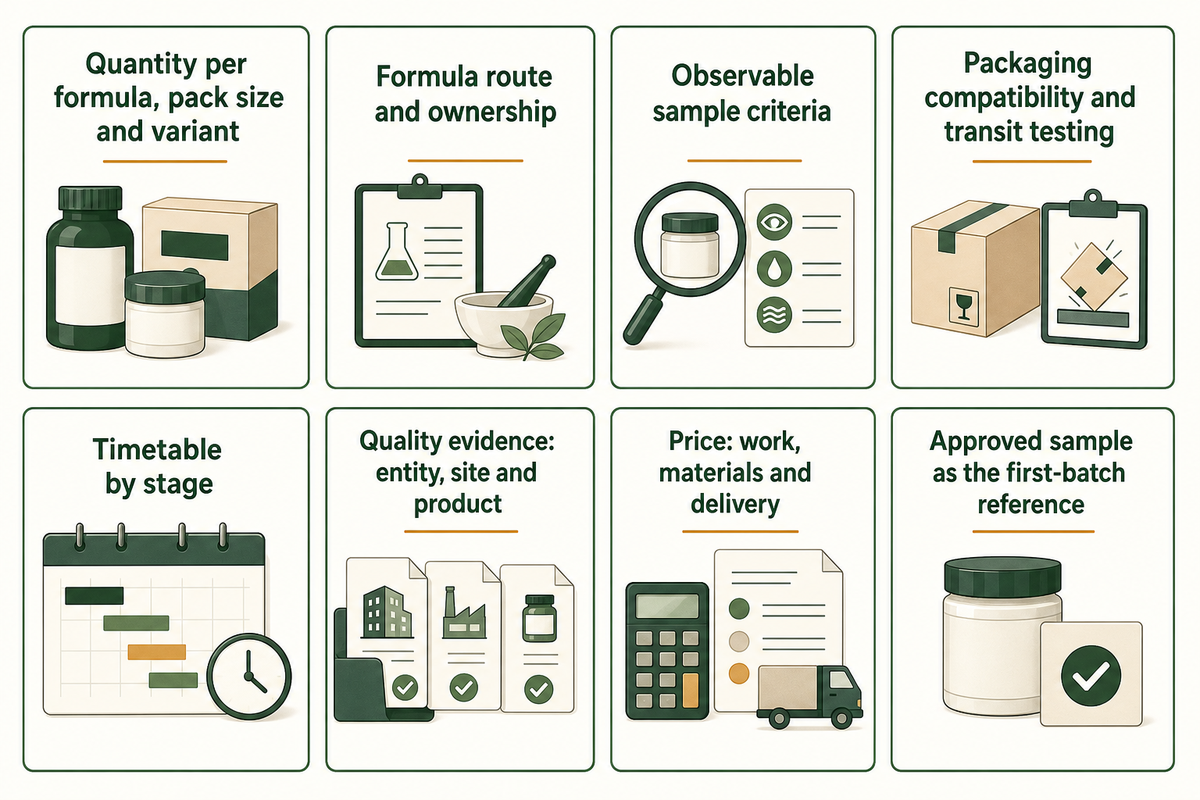
A clear description of the product and division of work precedes a request for a unit price. The tests below apply to private label shampoo manufacturing, custom contract manufacturing and bulk supply, but the answers will differ by route. Use them to compare what each proposal includes, especially when one manufacturer quotes finished product and another quotes only the formula.
-
State the quantity per formula, pack size and variant. Give the first-order quantity for each shampoo, its intended fill volume and the number of fragrances or other variants. Ask the manufacturer to separate the minimum order quantities for bulk formula, filling and packaging components. A 5,000-piece minimum per product isn’t automatically permission to divide that run among five different shampoo formulas.
How Do Minimum Orders in Kilograms Compare with Bottles?
Kilograms measure mass; bottles measure finished packs. For a planning estimate, theoretical bulk volume in litres equals batch kilograms divided by the formula’s measured density in kilograms per litre. Divide that volume by the fill volume expressed in litres to estimate bottle count, then allow for sampling, line loss and overfill. HSA’s 500/1,000 kg bulk starting points therefore can’t be compared directly with its 5,000-piece finished offer. John Drury’s litres and RainShadow’s gallons should likewise remain in their published units until the relevant filling assumptions are known.
-
Choose the formula route and settle ownership. Make the decision on whether the project requires white label shampoo, an adapted base or a new custom shampoo. In an off-the-shelf route, private labeling may cover the brand’s artwork and selected options and leave the underlying formula unchanged. In a bespoke route, development work may be included without automatically transferring formula ownership, exclusivity or the right to move the formula to a different factory.
Ask who owns the formula, who may sell it, which modifications are included and what documentation a future transfer would require. A private label manufacturer providing a catalog offering may be the right route to quickly extend a range; a brand seeking a differentiated wash feel may need custom cosmetic formulation. This distinction is equally applicable moving from private label skincare or other private label cosmetics to hair care.
- Turn the hair brief into observable sample criteria. Define target hair types, cleansing frequency, fragrance, lather, rinse feel and the desired appearance after drying. Hydrate can mean several consumer expectations. Hence describe the expected feel and appearance instead of promising a universal result. Provide a comparator and record the same observations across revisions of the sample. The right shampoo for a lightweight daily wash may be different from one that’s intended to have a rich post-wash feel.
For a natural and sustainable hair care concept, define the specific ingredient and packaging choices for the description. A private label organic offer, an organic ingredient and a certified finished organic shampoo are different claims. Ask for evidence tied to the actual formula; the same applies to a cruelty-free shampoo claim. A sulfate-free formula shouldn’t become a promise of zero irritation or identical results for all consumers.
-
Assign packaging compatibility and transit testing. Identify bottle material, closure, pump, liner, decoration and intended shipment conditions. Ask who supplies each component, who approves samples and who pays when a component changes. The shampoo manufacturing process doesn’t end when the liquid leaves the mixing vessel: filling behavior, closure performance and the formula’s contact with the package all matter to the delivered product.
Use cosmetic packaging compatibility testing to structure the discussion around the proposed formula-and-pack combination. Request a documented plan covering compatibility, leakage and transport exposure rather than assuming an attractive stock bottle is already suitable. A thick shampoo in a pump and a more fluid formula in a flip-top pack create different dispensing questions. Solid shampoo solutions also need packaging decisions, as Twincraft’s specific moisture-barrier example illustrates.
-
Break down the timetable into stages. Request separate estimates for the initial sample, revision, testing, artwork approval, packaging procurement, manufacturing and dispatch. Identify what has to come, or be approved, before each of these stages can begin. A sample date does not establish the shipment date for a finished order, particularly when bottles, pumps and decorated components have their own schedules.
While planning a private label hair care line, include companion products and shampoo on the same planning sheet but retain their individual dependencies. A formula-ready shampoo doesn’t make a conditioner ready for production. The cosmetic product development process is valuable for separating development and production milestones. Forecasts should reflect assumptions and decision points rather than turn a supplier’s short sampling estimate into a guaranteed product-launch deadline.
- Match quality evidence to the named entity, site and product. Request the relevant current certificate, its holder, facility address, scope and validity dates. ISO 22716:2007 addresses good manufacturing practices for production, control, storage and shipment of cosmetics; it is not a test of shampoo performance. ISO’s standard listing identifies the standard as published and records its 2022 review confirmation. General references to GMP standards should lead to a specific manufacturing practices discussion.
Evidence for quality and safety must match the product ordered. A company’s registration, a facility’s certificate and a finished product’s certification are three separate entities. Ask what batch records, release criteria and batch quality checks support your order. When private label hair care manufacturing is arranged through a brand or division, establish the actual manufacturing entity and contractual responsibility rather than moving a certificate from one name to another.
- Break down the price into work, materials and delivery. Request a separate price for development, sample revisions, testing, bulk formula, filling, bottles, closures, decoration, freight and any storage service. Identify items that are excluded and conditions for a repeat order. A lower price for liquid can come with a larger packaging commitment, while a finished-unit quote may include tasks missing from a bulk quotation.
Compare quotations for the same formula route, fill size, packing specification and order quantity. Marketing phrases such as “products meet the highest standards” do not describe a costed deliverable. The best proposal names the requirements and acceptance criteria. The same applies to “high-quality” hair care solutions: the purchase needs an agreed sample, test responsibilities and a release specification, not a more emphatic adjective.
- Have the approved sample be the reference for the first batch. Record the formula version, fragrance, color, fill quantity, packaging components and approved artwork. Reach an understanding on how the factory will hold samples, identify batches, and act upon a result outside of the acceptance criteria. Ensuring your products meet the agreed specification requires a clear reference, and a documented decision process as opposed to an assumption that a good laboratory sample ensures every production outcome.
Check the manufacturing quality-control responsibilities prior to issuing the order. This is also the stage to ensure your shampoo label and claims match the approved product and target market. Every shampoo variant needs a clear identity in the records, so a fragrance revision or packaging substitution cannot quietly become a different product from the one the brand accepted.
What does private labeling include in the quoted service?
Private labeling is a commercial arrangement rather than a fixed set of services. One factory may supply a finished, labeled shampoo; another may manufacture bulk while the buyer organizes the package. Among private label shampoo offers the most useful comparison is the responsibility split: formula work, testing, and component procurement; artwork; filling; and shipping. A private label shampoo manufacturer, with a small catalog minimum, may require a separate order for special packaging.
This also means a private label haircare buyer can protect brand identity. The product name, scent, wash feel and packaging should align with your brand, but each choice creates different work. Changing artwork does not necessarily change the formula. Changing the formula can impact testing or the compatibility of the packaging. Cosmetic manufacturers offering private label manufacturing can help you create a range only within the services actually contracted; therefore, make those limits clear.
How does a shampoo manufacturer differ from a supplier?
“Production” involves the manufacturer; a “supplier” can mean the seller, including a distributor. Shampoo contract manufacturers may develop and produce a formula, manufacture a customer-owned formula, or combine those activities with filling. A retailer or sourcing platform can sell shampoo without operating the manufacturing process. This list uses evidence of production operations and a shampoo offer to distinguish manufacturing services from product resale.
Contract manufacturers tend to describe their role through formulation, mixing, and filling, but the contracting party and the production site should appear in the purchase documents. A supplier’s promise of products that meet the highest standards is no substitute for identifying the producer and their agreed specification. Private label shampoo production doesn’t imply that a factory manufactures every other hair care product a brand may want. A paired conditioner, treatment or styling item remains a separate formula and production requirement, even if supplied in a coordinated program.
Frequently Asked Questions
Which shampoo manufacturer is best for a small first order?
Choose a stock formula for the smallest published starting quantities.
The answer depends on how much formula customization the first order needs. Pravada lists ready-to-brand products from 50+ pieces per stock-keeping unit, Envii’s Daily Cleansing Shampoo starts at 60 bottles, and DLAB lists an online shampoo route from 100 units. Those are specific existing-product offers. A unique formula moves into a different development route, often with a larger commitment than the smallest catalog quantity.
How much does it cost to manufacture shampoo?
Compare quotes only after fixing the formula, packaging and order specification.
There is no comparable public price covering all 20 manufacturers and the same product specification. Cost varies with formula route, batch size, fill volume, bottle and closure, decoration, testing, and delivery. Private label shampoo pricing is also affected by the work included: a bulk-liquid quotation and a finished branded bottle are different purchases. Separating one-time development costs from repeat production costs is helpful for comparing prices.
Can I create my own shampoo using a ready formula?
A ready formula can carry your brand without becoming your exclusive formula.
Yes, you can create your own private label shampoo around an existing formula, within the manufacturer’s available options. This may involve choosing a product, fragrance, artwork, and packaging system rather than creating a new cleansing system. A reduction in initial development work can be achieved by launching a shampoo line in this way. As far as the world of private label shampoo is concerned, ownership and exclusivity of a formula depend on the agreed commercial terms; putting your label on the bottle doesn’t give you ownership or exclusivity.
Who is the largest shampoo manufacturer in the world?
The available production figures do not support a shampoo-only global ranking.
Publicly reported figures do not provide a comparable shampoo-only global ranking. Group-wide cosmetics production, revenue and factory counts cover different categories and cannot give a shampoo-only size ranking.
Can I pair shampoos with matching conditioners or treatments?
A coordinated range still needs a separate specification for each product.
Yes, several manufacturers in this list offer shampoo alongside conditioner, including NEXO, HSA, John Drury and Royal Sanders. NEXO’s matching conditioner production can form part of a coordinated development brief. Pairing means agreeing how the two products should work within the same routine, including fragrance direction, wash feel, packaging and positioning. It doesn’t merge their formulas, minimum orders or acceptance criteria. A treatment or mask adds another product requirement, so the range plan should retain the quantity, development status and launch dependencies of each item.
Which manufacturers offer US-based shampoo production?
Match US production options to your order size and development needs.
For US manufacture, compare Nutrix, The Pure Source, Dynamic Blending, Libby Labs and Shay Labs against the formula route and order size. Shampoo manufacturers in the USA offer different service packages; location alone doesn’t determine launch fit.
Shortlist Manufacturers Around Your Shampoo Brief
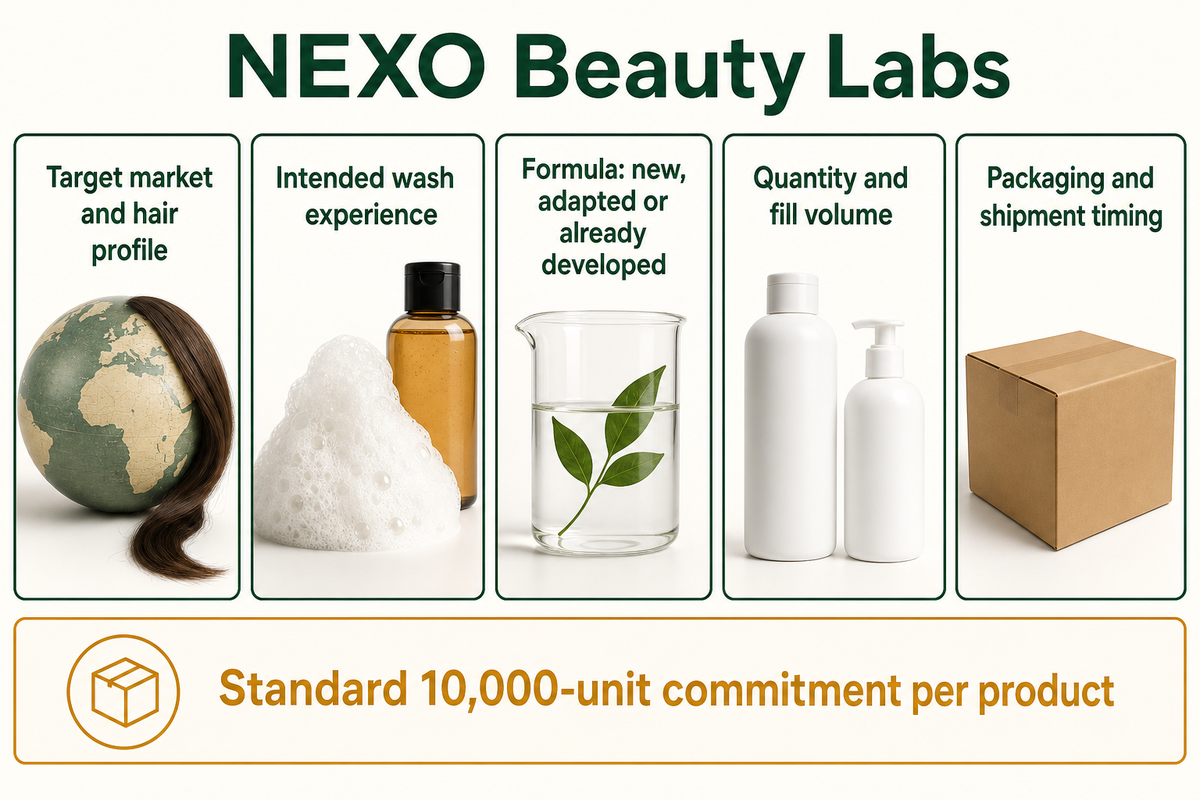
The best match is the manufacturer whose actual service aligns with the product, order and work your team needs. Ready-formula private label hair care may work for an initial range test. Development partners fit a more specific formula brief, and bulk suppliers and format specialists solve different production needs. The hair care industry includes all of these models, so an established name may not be as helpful as a proposal that fits your project.
For NEXO Beauty Labs, the relevant starting point is a custom shampoo project able to carry the standard 10,000-unit commitment per product. Prepare the target market, hair profile, intended wash experience, initial quantity, fill volume, packaging direction and desired shipment timing. Include whether the formula is new, adapted or already developed, and whether a companion conditioner belongs in the same launch.
Send that brief through NEXO’s project enquiry page for a scope discussion and quotation. A clear brief gives the manufacturer something concrete to assess and gives your team a basis for comparing the next proposal on the same terms.
References & Sources
- GAR Labs factory tour (2008) Cosmetics Science Technology.
- ISO 22716:2007, Cosmetics, Good Manufacturing Practices (GMP) International Organization for Standardization.