Get in touch with NEXO Beauty Labs Company
Private Label Sunscreen: A Complete Guide for Beauty Brands

Updated October 2026 · By Karry
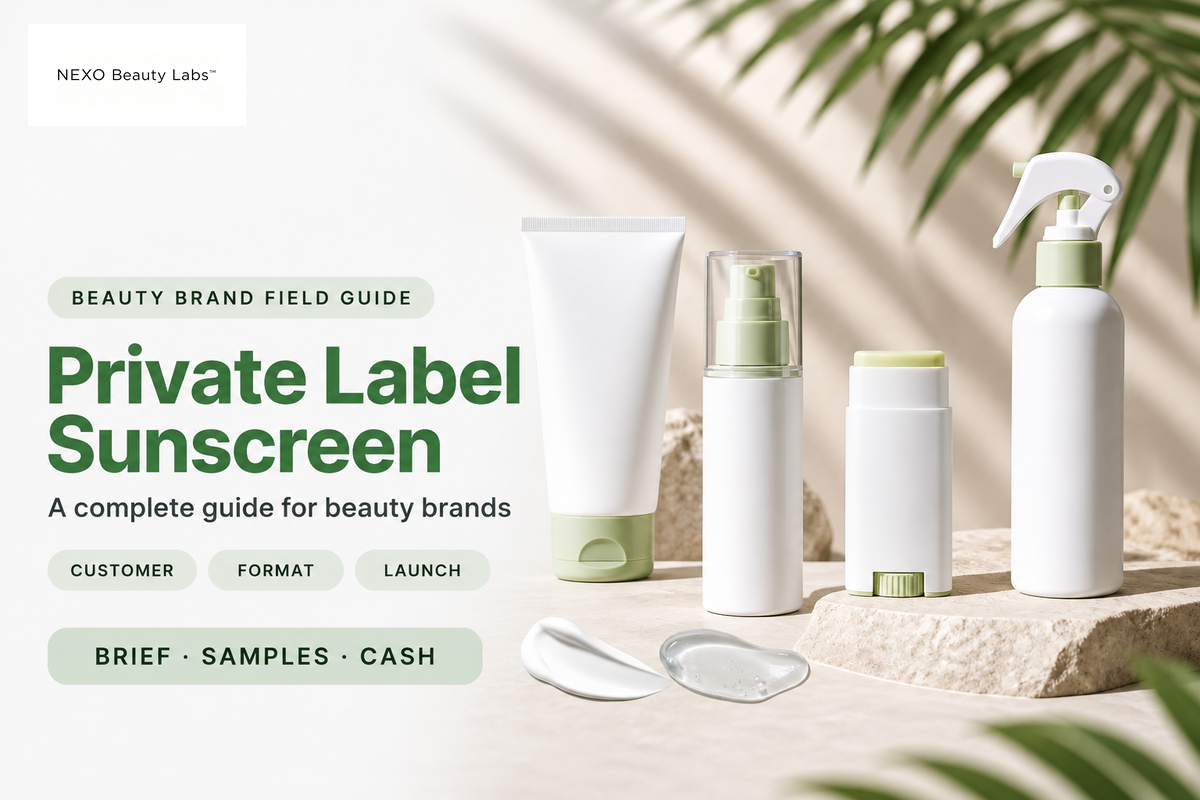
Private label sunscreen permits a brand to sell a manufacturer’s product under its own name, based on the scope defined in the contract. A useful launch starts with a particular customer and routine, then connects samples, packaging, market requirements and cash commitments. This document details nine brand decisions, a filled-out first-order budget and a wear-feedback diary.
A daily facial product sold online may present different choices from a large family size bottle for outdoor use. Though they may carry the same headline protection claim, they may require different textures, packs and launch plans. Sun care products need to occupy a specific place in the customer’s routine. The first step is to determine which experience a customer is willing to pay for again.
Before commissioning a sample
Choose the destination market, intended wearer, application routine, first format and spending limit. Keep the commercial brief separate from the product’s protection claims: one describes what you want to sell; the other needs applicable substantiation.
What Private Label Sunscreen Includes Before You Commit
Private label sunscreen joins a supplier’s development or production work with a brand’s positioning and sales work. The agreement determines whether you receive a stocked product, an adapted base or custom development. It also determines what costs are included in the price, what can be changed, and who owns the rights.
One private label manufacturer may provide a fully packaged product; another may quote bulk formulation and filling separately from components or artwork. Comparing prices without matching scope may give a false sense of savings. See what’s provided before comparing prices. Compare the right private label sunscreen manufacturer for your scope on filled products, decoration, component supplies and destination review. Identify what isn’t provided in the scope and who will perform that work.
Terms such as white label and private label are used differently between suppliers. Exclusivity, formula ownership, transfer rights and permitted modifications should be included in the contract rather than inferred from the service name. Our private label and white label contracts guide describes the differences for skincare projects.
For emerging brands, the attraction of stock formulas is a smaller development task. These sunscreen products still need a defined proposition: a stocked base can help brands focus resources on a useful pack and clear routine. An acceptable existing texture can free attention for pack usability, merchandising and the launch. An acceptable stock range can be ideal for brands testing a focused proposition, and should fit the actual audience. Custom formulation should be relevant only when a specific requirement is unmet, not simply because a custom product sounds more prestigious. For a premium private label sunscreen, define the added customer value before paying for extra development.
If the supplier says that everything is included, ask for a written list covering samples, product evidence, packaging, labels and delivery. A manufacturing partner can coordinate several workstreams, but a single contact does not make every commercial or market responsibility disappear.
Define the Customer and the Daily-Wear Promise
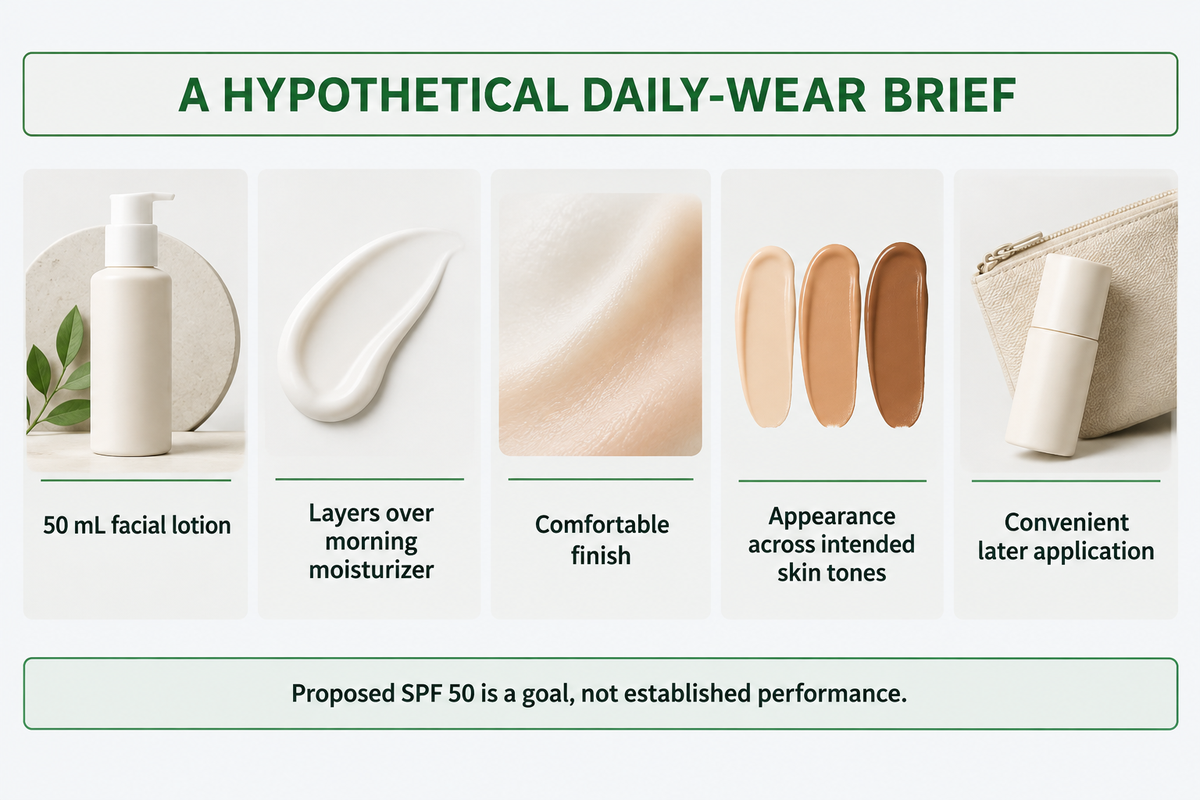
Create the brief around a customer who uses the product in a repeatable, observable way. Identify where it fits among their skincare products, the finish they prefer and the friction they want removed. “For every skin type” provides less direction to a development team than a clear first audience and a prioritized list of needs. Brands aiming for a daily sun protection routine should explain why repeat use is practical.
Hypothetical brief: A small, nouveau facial-care brand wants a 50 mL lotion for customers who apply makeup over their morning moisturizer. Its priorities are a comfortable finish, acceptable appearance across the intended skin tones and convenient later application. A proposed SPF 50 claim is a development goal until the finished product has appropriate support.
Compare that to a 150 mL private label body lotion for family outdoor routines. Portability, spread across larger areas and pack handling become different questions. Adding the facial and body formats together would also turn one development decision into two launch commitments.
What’s the difference between mineral and chemical sunscreens?
Mineral sunscreens use zinc oxide, titanium dioxide or both as filters; chemical sunscreens use organic filters, while hybrid sunscreens combine filter types. Zinc oxide and titanium dioxide can occur together. These help describe a formulation, but the finished good determines its feel, look and supported performance. Compare actual samples to each other.
The oft-repeated statement that mineral filters “only” reflect light is misleading. Cole, Shyr and Ou-Yang’s original study on oxides found that the primary mechanism of action was absorption. That doesn’t tell us which finished mineral and chemical sunscreen will work best for a given individual, however.
For a sensitive skin or acne-prone skin audience, identify the product experience and the claims the assessment can substantiate. Neither a filter category nor a pleasant sample establishes individual tolerance. Prefer not to put a small, unrepresentative group at risk by asking them to test for irritation or deliberately exposing them to UV.
Choose Stock, Adapted or Custom by the Difference You Need
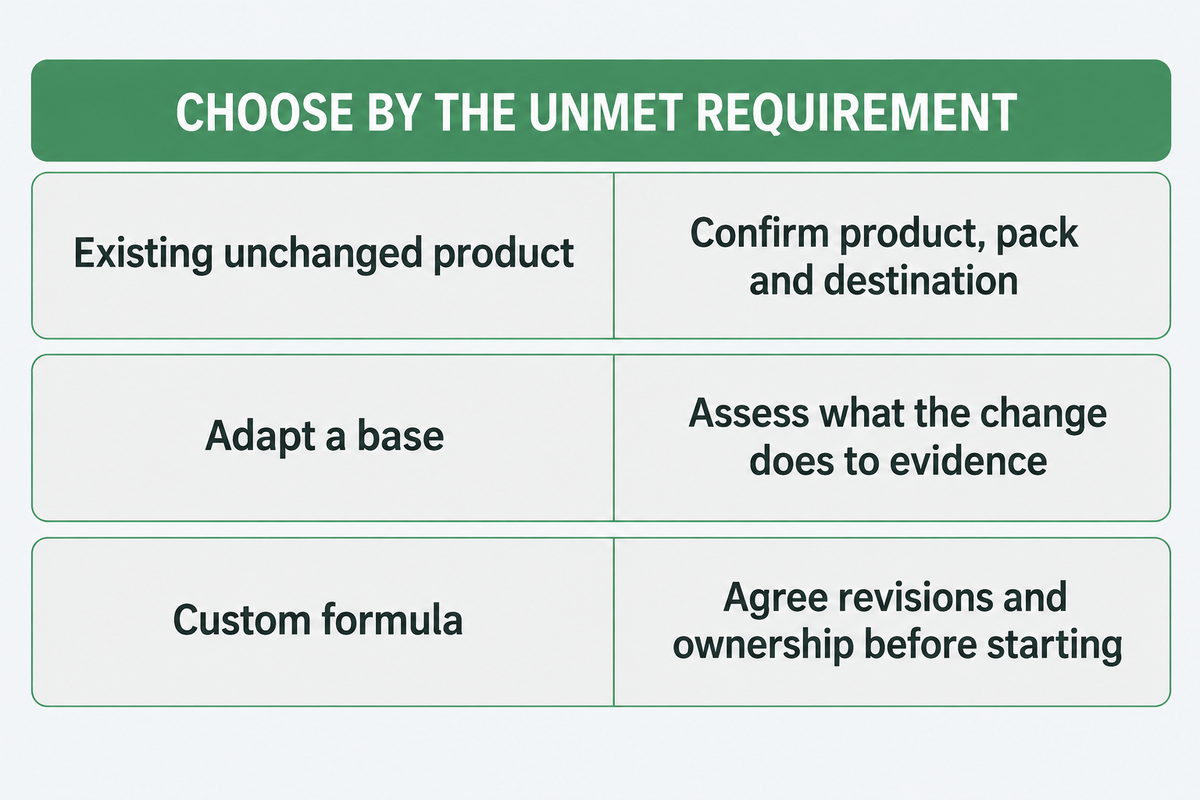
Choose the least onerous development route that satisfies the product brief and the type of evidence required by the brief. A stocked option fits existing requirements; adaptation addresses a defined gap, while custom development addresses requirements that available bases cannot meet. These are project scopes rather than an automatic ranking of quality or regulatory risk.
| Starting point | Useful fit | Decision before spending |
|---|---|---|
| Existing product, unchanged | Texture and appearance already meet the brief | Confirm exact product, pack and destination scope |
| Existing base, revised tint or fragrance | A specific customer preference is unmet | Ask qualified reviewers what the change does to supporting evidence |
| Custom formula | Required finish or format is unavailable | Agree development work, revision scope and ownership before starting |
Adding a tint to a base is still a product change. The word “minor” on a sample request doesn’t on its own determine whether existing SPF, stability, or other evidence remains relevant. Have the proposed change assessed prior to agreeing to a launch date.
A stocked platform also deserves scrutiny. The TGA’s shared-base sunscreen investigation shows why the adoption by several brands doesn’t provide reassurance. The account includes testing-laboratory reliability concerns and states that its GMP inspection did not identify manufacturing issues explaining the low SPF findings. It shouldn’t be used to prove that manufacturing was the cause of the issue.
If a contract manufacturer advises adaption, understand which customer requirement is fulfilled and what new work is created. A revision that adds cost without improving the chosen routine may be a poor choice for brands working with a limited launch budget. Comparing sunscreen formulations against the same priorities supports the discussion.
Start With a Manageable Product and Shade Range
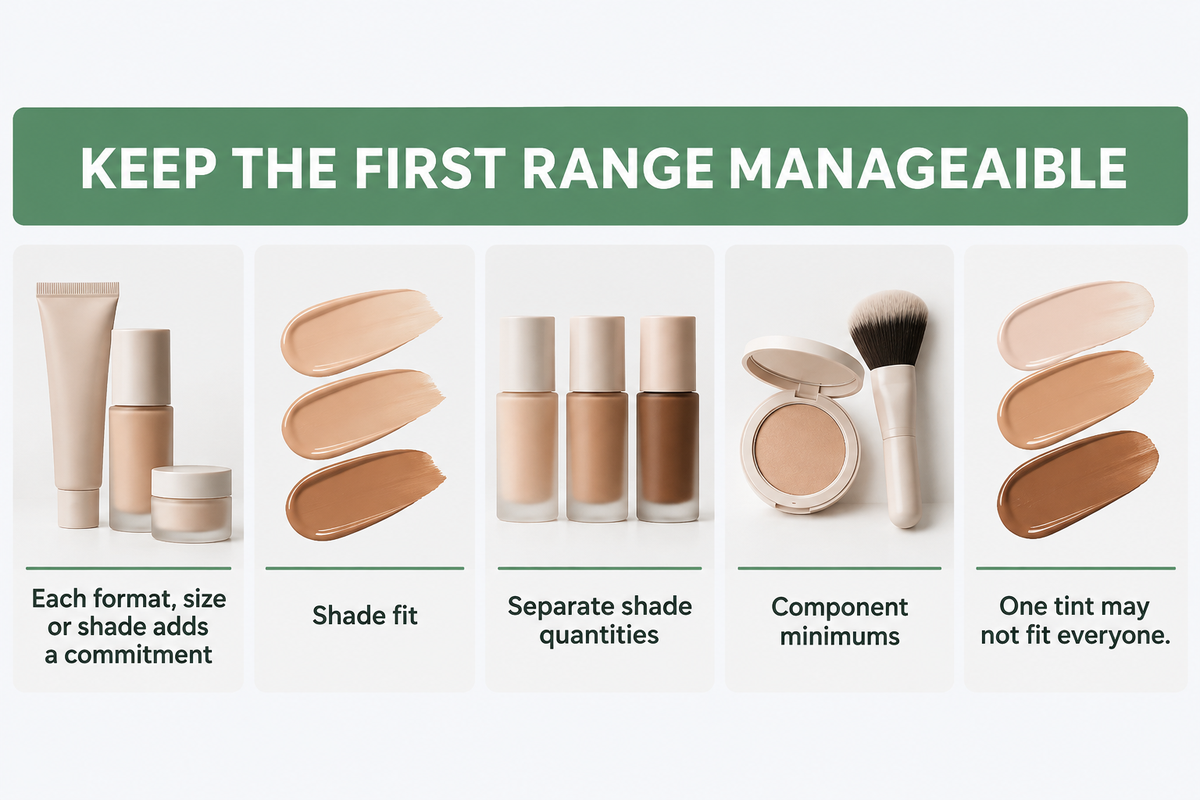
Determine an initial range that your evidence, budget, and demand will allow. Each format, size, or shade adds a commercial commitment that must be tracked. A narrower launch can make early feedback easier to interpret, although the right starting range depends on whether the selected audience can actually find a suitable product within it.
For the hypothetical launch of tinted sunscreen, one shade may simplify purchase decisions but could still leave part of the target audience without an appropriate alternative. Launching multiple shades creates a different set of inventory decisions. Resolve the tension with shade-fit feedback and scoped component quotes, rather than assuming one tint fits everyone or splitting a single sales forecast equally among shades.
| Product direction | Customer question | Commitment to clarify |
|---|---|---|
| Daily facial fluid | How does it layer with the intended routine? | Finish and dispensing system |
| Tinted mineral sunscreen | Which wearers find the shade acceptable? | Separate shade quantities and evidence relevance |
| Body lotion | Is spreading and handling convenient? | Fill size and usable pack |
| Outdoor cream | Which use conditions will the label address? | Support for proposed water-resistance claims |
| Stick | Does the format fit the intended application? | Format-specific development and claim review |
| Non-aerosol spray | Can users follow the intended application directions? | Sprayer and destination requirements |
| Aerosol spray | Does convenience justify the added pack scope? | Container system, transport and applicable rules |
| Travel size | Is portability the purchase reason? | Component minimums and decoration cost |
| Powder format | What specific use and claim are proposed? | Method applicability and market assessment |
MOQs should be verified for saleable variation and component, with their units stated. Low MOQs for filled units may coexist with a larger decoration commitment. The delivery system for indie brands considering sunscreen sprays requires attention before the artwork is commissioned, rather than after a sample has been approved.
Use Wear Feedback to Decide What the Sample Must Change
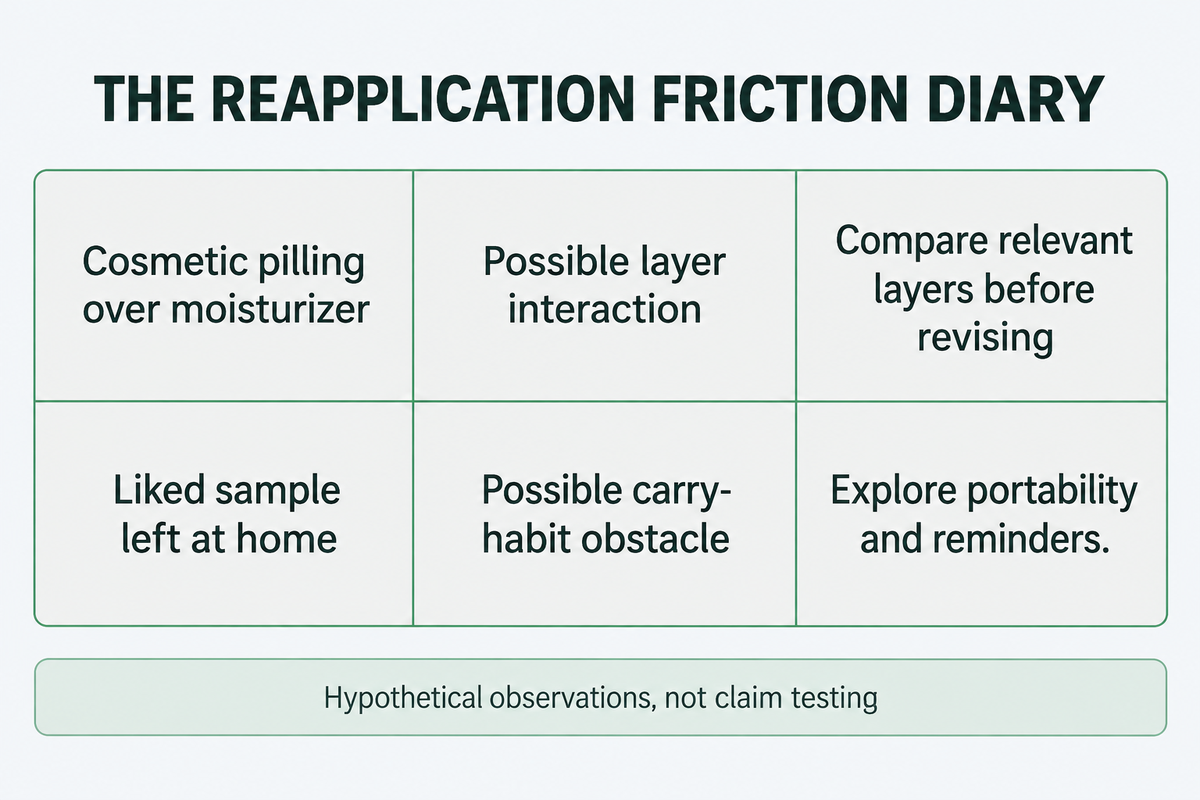
Use wear feedback to identify the next development question. Explain the routine, what actually happened and a possible alternative before requesting a formula change. A sample diary can help separate texture, packaging, instructions and price objections; it can serve a different function from testing protection claims or assessing clinical safety.
“The real goal is reapplication.”
Feel is only one barrier. A 2026 survey of 739 White US adults found that 24.2% of the respondents disliked sunscreen’s feel or smell, and 52.1% of respondents reported forgetting to bring or apply it. While the population limits broader generalization, for a brand it’s important to understand why a customer doesn’t use a product. Reformulation won’t resolve all the reasons a customer skips an application.
| Routine and observation | Alternative explanation | Commercial implication | Next action |
|---|---|---|---|
| 50 mL facial sample pills over one moisturizer | Layer combination or application sequence | The advertised routine may disappoint | Compare the relevant layers before requesting a revision |
| Tint looks acceptable indoors but mismatched in daylight | Lighting changed the assessment | Shade returns could concentrate in part of the audience | Repeat shade-fit observations in consistent lighting |
| 100 mL pump feels convenient but output is inconsistent | Priming, closure or fill interaction | Pack convenience may conceal a dispensing problem | Send pack and batch details for functional evaluation |
| Customer likes the sample but leaves it at home | Carry habit or pack size | Changing skin feel may miss the actual obstacle | Explore pack portability and routine reminders |
We have a separate guide for packaging. In a randomized laboratory study of 94 campus participants, participants applied approximately 30% less sunscreen from the tested pump bottles than squeeze bottles. The finding is specific to the devices and the setting of the study. It doesn’t universally indict pump bottles.
Keep in-house preference notes separate from claim-testing records. When recording a dispensing issue, document the sample code, container, observed behavior and routine. As sunscreens often move between a bathroom, a bag and outdoors, document the location of the issue. Our packaging compatibility evaluation guide provides more information; Intertek also differentiates stability testing from final-pack compatibility and function.
Separate First-Batch Cash From Reorder Economics
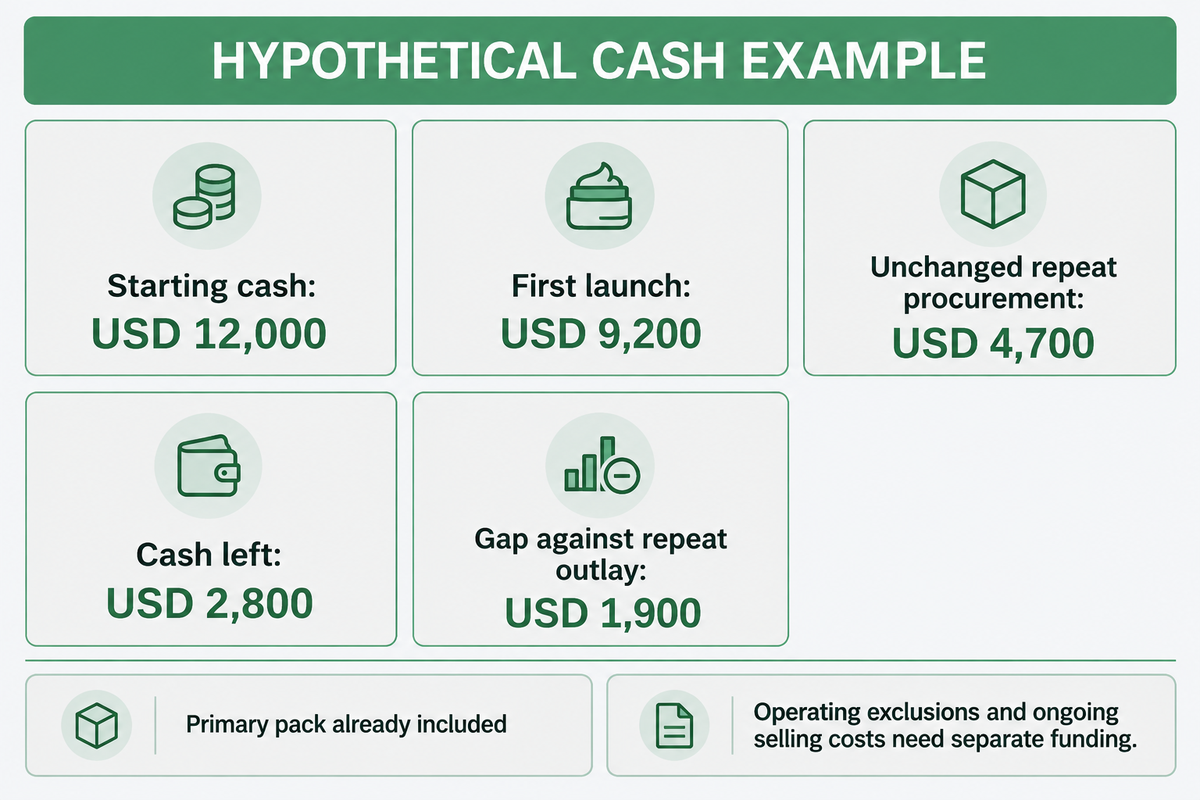
Initial development and artwork costs incurred in the first production run are different from costs expected in subsequent production runs. Add delivery and selling costs, then record payment dates. The first order and the next order answer different questions: what costs are incurred to get the product ready for sale and what costs are needed to sell the product?
How much does it cost to start a sunscreen brand?
The hypothetical launch below uses USD 9,200 before the listed operating exclusions. Actual startup cost combines development, artwork, production, delivery and selling expenses for the chosen format and destination. The example below shows how to build the calculation. All amounts are hypothetical US dollars, not a NEXO quotation, industry average or forecast of business results.
| Assumed cash item | First launch | Repeat order |
|---|---|---|
| 1,000 filled units × USD 4, including primary pack | USD 4,000 | USD 4,000 |
| Initial development, testing and design allowance | USD 3,000 | USD 0 if unchanged scope requires no new work |
| Freight allowance | USD 700 | USD 700 |
| Initial launch promotion allowance | USD 1,500 | Excluded; continuing selling costs still need funding |
| Cash covered by the rows above | USD 9,200 | USD 4,700 |
| Assumed starting cash | USD 12,000 | No new funding assumed |
| Cash left immediately after first-launch outlays | USD 2,800 | Before sales receipts and further expenses |
| Gap against the assumed repeat-order outlay | USD 1,900 | Before receipts, overhead and continuing promotion |
| Outside this worked scope | Taxes, duties, storage, retailer/platform fees, returns, payroll, insurance and other operating costs | |
The primary pack is already contained in the USD 4 unit assumption; adding it again would double count it. The Repeat column compares procurement costs. Changes to the pack, formula, label or destination may bring about new work and different costs.
According to the US Small Business Administration’s planning guidance, one-time and monthly costs are separated. Place the quoted payment dates next to that distinction. The brand can’t fund a supplier’s earlier deposit with retail revenue received later.
Ask the private label sunscreen manufacturer to document exclusions and assumptions. An SPF manufacturing quote should distinguish product preparation costs from ongoing selling costs. Low moqs may decrease initial inventory, but still leave costs for design and/or testing spread over fewer units. For a sunscreen brand selling at retail, include the channel’s payment terms before considering the cash gap resolved.
Assign Market Readiness and Launch Work to Named Owners
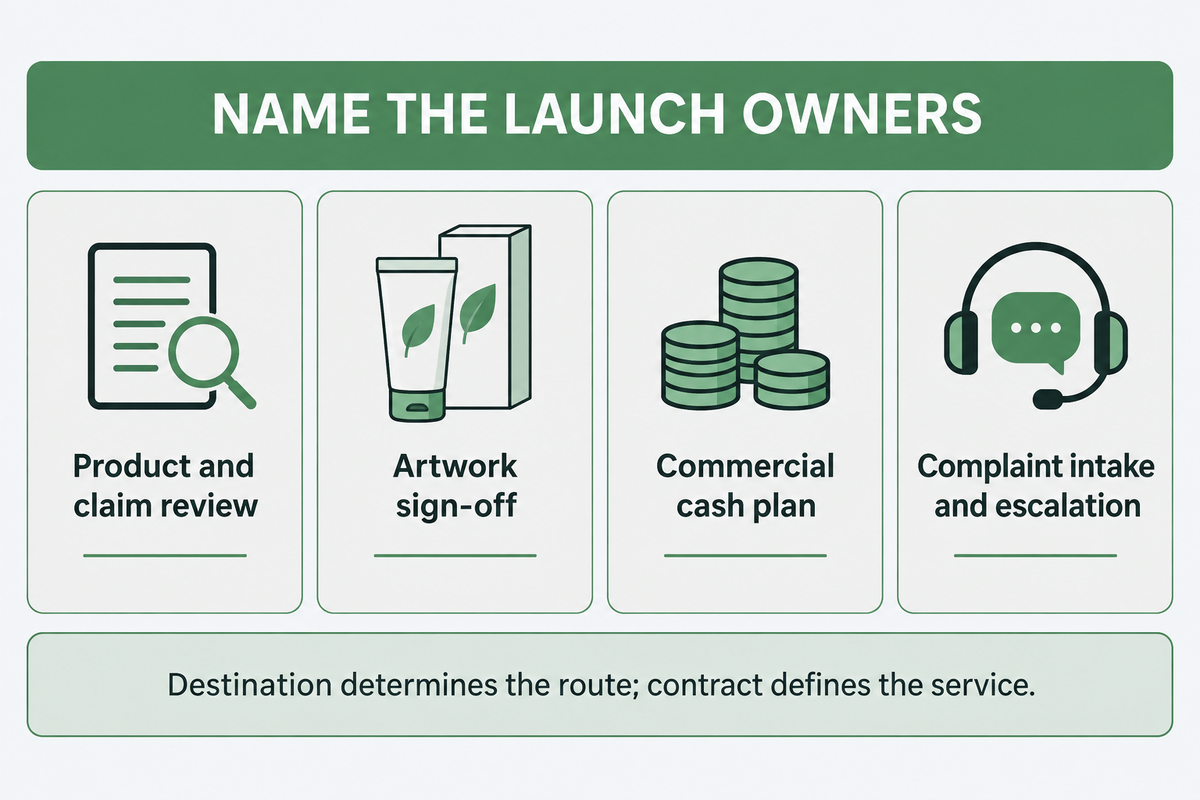
Prior to launch, identify personnel assigned to product, label, commercial and post-market work. The destination determines the regulatory route; the contract determines who performs each service. A brand should be able to name the individuals reviewing the exact product and supporting claims, signing off artwork and dealing with post-shipment customer concerns. Brands need to identify those people before committing to printed packs.
In the US, sunscreens are regulated as drugs. An OTC drug route includes applicable formulation, testing and sunscreen labeling conditions. SPF and broad-spectrum protection respond to distinct test questions; a high SPF number alone doesn’t satisfy UVA and UVB claims. US water-resistance labels use 40 or 80 minutes when supported by the relevant product testing.
An “FDA-registered private label” supplier description needs an activity and facility check. Under 21 CFR Part 207, a private-label distributor that does not manufacture, repack, relabel, or salvage is not required to register under that part. Registration and listing do not equate to approval; listing responsibilities and actual activities should be evaluated.
The EU cosmetics framework provides for an EU responsible person, safety report and notification. Australian rules treat primary and some secondary sunscreens as therapeutic goods, with conditional exclusions for certain secondary products. See TGA rules; label copying across markets can be misleading.
Refer to the sunscreen manufacturing Guide for detailed answers on production and testing. To obtain a brand handoff, add the below to your quote request and fill in the actual scope in place of each starting scope.
| Parameter | Recommended range | Why it matters | How to verify |
|---|---|---|---|
| Initial market | 1 named destination in the starting brief | Sets the review scope | Qualified reviewer confirms applicable route |
| Initial product | 1 proposed 50 mL facial format in this example | Bounds the first quote | Match sample, fill and component references |
| Shade scope | Every proposed shade listed separately | Keeps variants visible | Confirm quantities and evidence relevance per change |
| Protection target | One exact claim proposal, such as SPF 30 | Connects brief with substantiation | Qualified review of applicable reports and label |
| Cost scope | One itemized first-order and repeat-order comparison | Shows exclusions and cash dates | Finance checks written quote and payment terms |
| Postmarket owner | Named complaint intake, escalation and record contacts | Preserves responsibility after delivery | Agree reporting and record procedures before sale |
US postmarket obligations require a separate discussion. 21 USC 379aa assigns reporting and record obligations to the label-named manufacturer, packer or distributor within its scope. Establishing an intake and escalation process is more helpful than assuming that an exception from registration removes postmarket obligations.
Plan the Second Order Before Spending the First One
Base the replenishment quantity on actual demand and schedule payments around available cash. Track saleable stock, returns and receipts. Track supplier payment dates and usable lead times. The idea is to find a cash or component constraint as early as possible, not to promise a universal reorder point before the first customer has bought.
In the worked example, the remaining cash is less than the expected repeat procurement outlay. Sales may help, but only receipts available by the next payment date can fund it. Finance should maintain cash for selling costs rather than assuming every sales receipt frees funds for production.
Procurement needs a fresh schedule when the next order includes a different closure, revised artwork or another shade. The production slot is only one part of the wait. A new component may require evaluation and approval before sunscreen production starts.
Also consider the inventory’s usable selling window. US drug expiration rules relate dating to stability and storage conditions and contain a conditional OTC exception. They don’t provide that every batch has three years of remaining shelf life. Agree the required remaining life at receipt against the actual product and channel.
Relevant lot identity should be maintained with quality and operations. See our batch-code traceability guide for the records. Complaints and repeat purchases should be reviewed and sell through assessed before additional sunscreen options are added. A fast first promotion can be a good signal of demand without indicating durability of demand.
Read the 2026 Filter Changes as a Brand Investment Decision
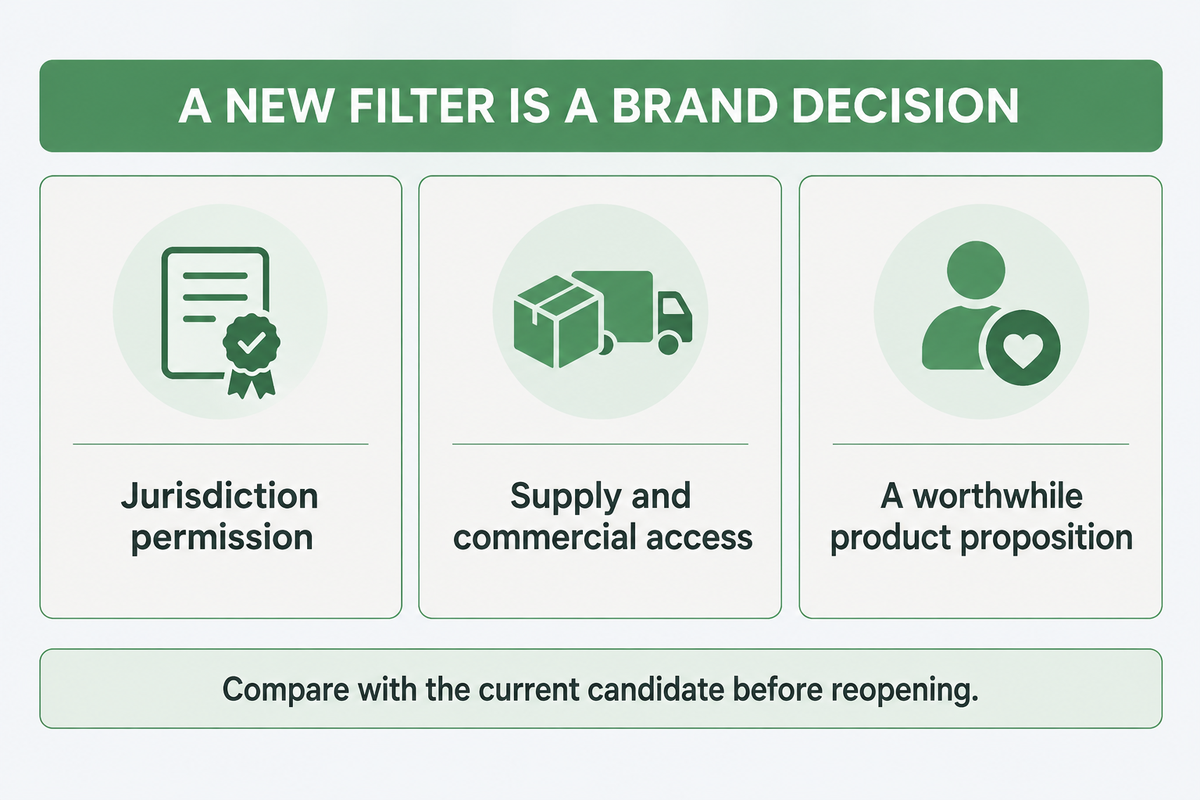
An expanded filter permission should prompt a review of the brief and a decision on whether to reopen, rather than an automatic reopening. Ask whether the available formulation would solve a customer problem well enough to justify additional development, evidence and commercial work. Filter permission in a jurisdiction, supply access and a worthwhile product proposition should be assessed separately.
The June 2026 Federal Register notice announces FDA order OTC000039 adding bemotrizinol at concentrations up to 6%, subject to the amended monograph’s conditions. Review the operative order and any applicable commercial rights with a qualified partner before committing to a US launch; the announcement alone is not a complete access plan.
A different September 2026 notice indicates the final order removing both PABA and trolamine salicylate. That notice also says other aspects of the 2021 proposal will be addressed in subsequent orders. Look at the appropriate effective dates and transition conditions and don’t treat every proposal as current law. Specific claims supported by evidence are still required for High-performance sunscreens. A more recent ingredient history doesn’t replace that evidence.
For brands seeking an innovative sunscreen, the final say is still with the wearer: what improves, what changes with the pack or routine, and what added effort is required? Request a comparison against the current candidate before replacing an acceptable launch product merely to carry a newer ingredient story.
Private Label Sunscreen Questions
Do I need FDA approval to sell private label sunscreen?
A compliant US monograph sunscreen can be marketed without an individual approved drug application, provided it meets the applicable conditions.
The route still requires review of the exact formula, dosage form, testing, labeling and business activities. Select sunscreens that meet the applicable conditions for the proposed market. A product outside the monograph conditions needs separate assessment. Facility registration, drug listing and an NDC are not product approval. Establishment duties depend on actual activities, while the label-named business can also have postmarket responsibilities. Confirm the route before ordering printed packs.
Can private label sunscreen be sold at retail?
Private label sunscreen can be sold at retail when the product meets the destination’s requirements and the retailer’s onboarding conditions.
Ask the retailer for its current document, barcode, insurance, packaging and remaining-shelf-life requirements before finalizing the order. Match those requirements to the supplier’s agreed deliverables and your own responsibilities. Retail payment terms also belong in the cash plan: stock shipped to a store may create a receivable rather than immediate funds for the next production deposit.
What is the shelf life of aerosol private label sunscreen?
Aerosol sunscreen shelf life depends on support for the actual formulation and container system under the relevant storage conditions.
Obtain the applicable dating information for the specific product rather than borrowing a duration from another aerosol. Formula stability, dispensing function and package compatibility address related but different questions. Check the remaining selling window when stock arrives, alongside channel requirements and shipping time. Any applicable US OTC dating exception is conditional; it does not establish a universal period for every aerosol product.
Can I make a reef-safe or mineral-only private label sunscreen?
A mineral-only brief is a formulation choice; a reef-safe claim is a separate environmental claim requiring its own assessment.
Do not equate excluding oxybenzone and octinoxate with demonstrating that a finished product is harmless to a reef. Specify the exact claim, destination and supporting basis before placing it on the label.
Can private label sunscreen be called natural or organic?
Natural or organic wording needs a defined meaning and support appropriate to the intended market and certification claim.
Organic sunscreens in filter chemistry and certified-organic marketing refer to different concepts. A natural mineral sunscreen description also needs careful claim review. Keep the finished product’s protection claims tied to its applicable evidence, regardless of the ingredient story. An SPF product requires the same care in claim wording when the brand emphasizes natural ingredients.
Does private label sunscreen cause acne?
Private labeling does not determine whether an individual will experience acne or tolerate a sunscreen.
Assess the actual product and any proposed non-comedogenic claim with appropriate expertise. A brand sample diary records preferences; it cannot guarantee a safe sunscreen for every person or establish treatment claims. Wording about preventing skin damage needs its own qualified review.
Can one sunscreen formula be sold in the US, EU and Australia?
A shared formula may be feasible, but each destination needs its own assessment of composition, product classification, evidence, labeling and responsible parties.
Check permitted filters, applicable evidence, local roles and pack text. Acceptance of a sunscreen active ingredient in one destination does not create worldwide permission; different product versions may be needed.
Turn the brief into a scoped project
Send the intended market, daily routine, candidate format, shade scope and launch cash limit when discussing NEXO Beauty Labs’ private label sunscreen manufacturing options. Ask for an itemized first-order scope and an unchanged-repeat comparison so the next decision is tied to a product and a payment plan. Check the programme’s destination-market and minimum-order scope first. NEXO describes its facility as a cosmetic facility; US OTC projects need a qualified US drug-manufacturing route.
NEXO Beauty Labs develops and manufactures skincare, hair care and body care products. Its manufacturing foundation dates to 1999, with international brand support since 2020. This guide reflects that commercial perspective.
References & Sources
- Labeling and Effectiveness Testing of Sunscreen Drug Products FDA; read alongside current administrative orders.
- Drug Establishment Registration and Listing, 21 CFR Part 207 eCFR.
- Cosmetics legislation European Commission.
- Sunscreen regulation in Australia TGA.
- Sunscreens using the same base formulation TGA, 2025 investigation updates.
- Metal oxide sunscreens protect skin by absorption Cole, Shyr and Ou-Yang, original 2016 study abstract.
- Sunscreen Use Barriers in White US Adults Hall and colleagues, 2026 original survey abstract.
- Dispensing Device and Label Warnings on Dosing Harben and colleagues, 2020 randomized trial abstract.
- There’s Plenty New Under the Sun Tom Branna, Happi, November 2025; industry practitioner reporting.
- Plan your business US Small Business Administration.
- Expiration dating, 21 CFR 211.137 eCFR.
- Serious adverse event reporting, 21 USC 379aa statutory text reproduced by Cornell Legal Information Institute.
- Bemotrizinol final-order notice Federal Register, June 2026.
- PABA and trolamine salicylate final-order notice Federal Register, September 2026.
Why beauty brands work with NEXO
About NEXO Beauty Labs Manufacturing Support
NEXO Beauty Labs supports skincare, body care, sun care, hair care, and private label brands with formulation, sampling, filling, quality control, and export-ready launch support.
Project Review Before RFQ
Before quotation, we help clarify product category, active direction, formula stage, package choice, compliance market, MOQ, sampling schedule, and required documents.
Request a Cosmetic QuoteCompany Profile // Data Sheet
CompanyNEXO Beauty Labs
Business TypeCosmetic OEM / ODM manufacturing partner
Main ProductsPrivate label skincare, facial serums, moisturizers, cleansers, sunscreen, body care, and hair care products
Manufacturing CapabilityFormula development, sample adjustment, package sourcing, filling, QA/QC, documentation, and export support
RFQ Data NeededProduct type, formula goal, package format, target market, MOQ, claims, timeline, and benchmark samples
Websitenexobeautylabs.com